| G4 receiver |
x = 60, y = 50, rule = B3/S23
57bobo$57b2o$58bo19$32bobo$32b2o$33bo5$16b2o$16b2o20bo$36b3o$35bo$35b
2o4$2o$2o$38b2o15bo$11b2o25b2o15bo$11b2o42b3o$57bo$8bo$6b3o$5bo$5b2o
24b2o$17b2o12bo$17b2o6bo6b3o$24bobo7bo$25bo!
#C [[ THUMBSIZE 2 THEME 6 GRID GRIDMAJOR 0 SUPPRESS THUMBLAUNCH ]]
#C [[ AUTOSTART ]]
#C [[ WIDTH 480 HEIGHT 320 THUMBLAUNCH THUMBSIZE 2 X -1 Y 10 Z 8 GPS 30 PAUSE 2 T 243 PAUSE 2 LOOP 244 ]]
|
|
| View static image |
| Pattern type |
Conduit |
| Input |
tandem glider |
| Output |
Herschel |
| Number of cells |
45 |
| Bounding box |
40 × 22 |
|
|
|
| Step |
Unknown |
Recovery time
(ignoring FNG if any) |
85 ticks |
Minimum overclock period
(ignoring FNG if any) |
Unknown |
| Spartan? |
Yes |
|
|
|
| Discovered by |
Sergey Petrov |
| Year of discovery |
2011 |
|
|
|
|
|
|
|
|
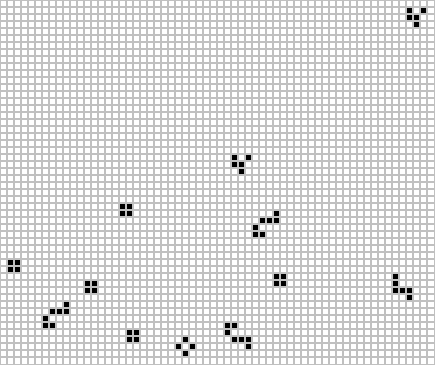
The G4 receiver is an alternate Herschel receiver discovered by Sergey Petrov on 28 December 2011.[1] It accepts a tandem glider labelled G4, meaning that the two glider lanes are separated by four half-diagonals. The first glider triggers a glider to 2 blocks converter, also found by him previously, while the second collides with the half-blockade to release an R-pentomino and an extra 90-degree glider.
In the pattern in the infobox, the R-pentomino is converted to a Herschel by RF28B and BFx59H, whose final output is marked by a ghost Herschel.
References
External links