Honeycombinator
Jump to navigation
Jump to search
- This article is about the induction coil. For the still life, see Honeycomb.
| Honeycombinator | |||||||
| View static image | |||||||
| Pattern type | Induction coil | ||||||
|---|---|---|---|---|---|---|---|
| Number of cells | 11 | ||||||
| Bounding box | 5 × 5 | ||||||
| Static symmetry | D2_+1 | ||||||
| Discovered by | Unknown | ||||||
| Year of discovery | Unknown | ||||||
| |||||||
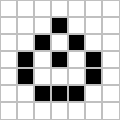
Honeycombinator is an induction coil. While it works in Life, it is not common; it is much more significant in certain OCA rules where it is much more common. For example, in Life, the most common honeycombinator + 7-cell induction coil (bun or bookend) is ranked #38 in most common 18-cell still lifes, and there are no others in the top 600 18-cell still lifes.
If left to evolve on its own, it stabilizes at generation 24 as a pair of tubs.
It contains a line of three and can be used in a spark coil.The most common period-2 oscillator to use a honeycombinator ranks 112th[1]; it has a honeycombinator on one side and a typical house on the other (honeycombinatorial spark coil).
| Meta-bun on honeycombinator (click above to open LifeViewer) RLE: here Plaintext: here |
| Honeycombinatorial spark coil (click above to open LifeViewer) RLE: here Plaintext: here |
See also
- G (induction coil)
- Honeycomb
- Eater 4, which it can be welded into for a higher clearance