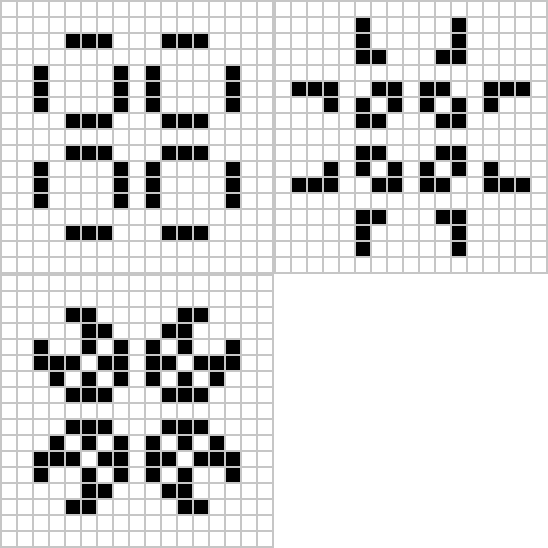
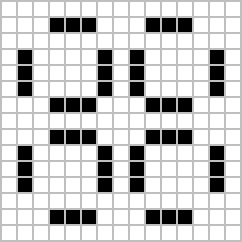
The rotor of a pulsar consists of four mutually stabilizing quadrants; alternate arrangements exist for any odd multiple of 4 (for the version with 12 copies, see quasar). A closely related oscillator — the pulsar quadrant — includes just the external "horns" of the rotor and can be stabilized on its own.
Two other oscillators, the bracket pulsar and cross, can be extended in much the same way.
Despite its size, pulsar is the fourth most common oscillator (and the most common of period greater than 2) in Achim Flammenkamp's census; the only oscillators more common are blinker, toad, and beacon.[2] It is by far the most common period-3 oscillator, being about 45,000 times more common than jam.[3] Overall, the pulsar is the twenty-first most common object on Adam P. Goucher's Catagolue.[4]
Compared to Catagolue's typical 16 × 16 soups, the pulsar is 30% more common in 8 × 8 soups and 14% more common in 10 × 10 soups; this is probably because a pulsar is more likely to survive if there is nothing around it.
The pulsar-on-pentadecathlon I is the largest object to have occurred in the B3/S23/C1 census as of July 2023, with 100 cells in its maximum phase, and with first known natural occurrence on Catagolue in April 2015.[5][4]
The smallest pattern by population that evolves into a pulsar has seven cells; there are several of these.[note 2]
There exists a heptomino, that acts as a p3 oscillator partial but can mutually stabilise with a quadrant of the pulsar's nucleus, replacing a standard horn in its blinker phase to comprise an "arm" and causing it to undergo a different period-3 evolutionary sequence. Due to its interference with the quadrant's nucleus, only a single arm may exist per quadrant. Despite an arm requiring the flipping of only six cells' states in this phase, no arm variant has occurred naturally, assumedly due to the pulsar's fragility. However, the twovariants with two arms in D2_+1 symmetry, and the variants with four arms in D4_+1 and C4_1 symmetry, have occurred seminaturally.
The same heptomino can also mutually support a quadrant from a different orientation, replacing another quadrant as one of its two supports, allowing two distinct two-quadrant half-pulsars with arms.
Two can support a highly volatile small period-3 oscillator that contains a tub in one phase (as seminaturally occurred in tetramer form) (click above to open LifeViewer) Catagolue: here
In other rules
In Pedestrian Life (B38/S23), the pulsar is about 400 times less common than in Life because the pre-pulsar does not evolve into it. However, there are new predecessors, making it still the most common period-3 oscillator.[8]
x = 12, y = 5, rule = B38/S23
2bo$bobo5b3o$o3bo4bo$bobo5b3o$2bo!
#C [[ THUMBSIZE 2 THEME 6 GRID GRIDMAJOR 0 SUPPRESS THUMBLAUNCH ]]
#C [[ HEIGHT 450 THEME Book ZOOM 20 X 2 Y 0 AUTOSTART GPS 8 T 0 PAUSE 3 T 44 PAUSE 1 LOOP 45 ]]
As a more extreme example, the pulsar is about 1500 times less common than in Life because the pre-pulsar does not evolve into it, instead involving to a common alien oscillator. Furthermore, there are no new predecessors, accounting for the extreme increase in rarity. Despite all of these, it still the most common period-3 oscillator.
On the other hand, in EightLife (B3/S238), the pulsar is 170 times more common than in Life because the pi-heptomino evolves into it.[9]
x = 3, y = 3, rule = B3/S238
3o$obo$obo!
#C [[ THUMBSIZE 2 THEME 6 GRID GRIDMAJOR 0 SUPPRESS THUMBLAUNCH ]]
#C [[ HEIGHT 450 THEME Book ZOOM 15 AUTOSTART GPS 15 T 0 PAUSE 3 LOOP 135 ]]
↑The numbers refer to the populations of the three phases. The Life pulsar was indeed discovered at Cambridge, like the first real pulsar a few years earlier.
↑An example is 3bo$o5bo$b2ob2o!, which evolves into another 7-cell predecessor after one tick.
↑There are 77 matches for the pulsar in the octo3g database (out of 464746 lines). There are also 404 matches in the octo3obj database (out of 3421907 lines), and 99 matches in the octohash database (out of 455380 lines). If all collisions with at least one occurrence of pulsar in the ash are included, then there are 632 results in the octo3g database (including three collisions with two pulsars in the ash), 4833 results in the octo3obj database (including 53 results with two pulsars in the ash) and 551 results in the octohash database (including two collisions with two pulsars in the ash).