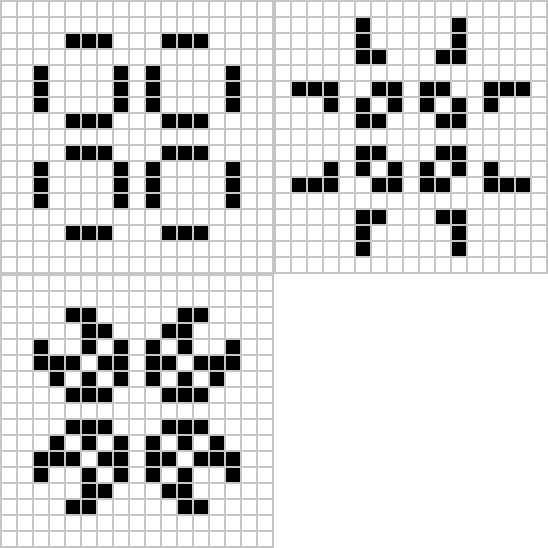
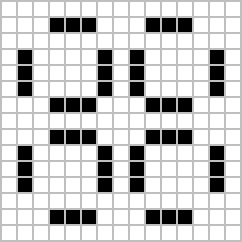
The rotor of a pulsar consists of four mutually stabilizing quadrants; alternate arrangements exist for any odd multiple of 4 (for the version with 12 copies, see quasar). A closely related oscillator — the pulsar quadrant — includes just the external "horns" of the rotor and can be stabilized on its own.
Two other oscillators, the bracket pulsar and cross, can be extended in much the same way.
Despite its size, pulsar is the fourth most common oscillator (and the most common of period greater than 2) in Achim Flammenkamp's census; the only oscillators more common are blinker, toad, and beacon.[2] It is by far the most common period 3 oscillator, being about 45,000 times more common than jam.[3] Overall, the pulsar is the twenty-first most common object on Adam P. Goucher's Catagolue.[4]
Compared to Catagolue's typical 16 × 16 soups, the pulsar is 30% more common in 8 × 8 soups and 14% more common in 10 × 10 soups; this is probably because a pulsar is more likely to survive if there is nothing around it.
A pulsar-on-pentadecathlon is the largest object to have occurred in the B3/S23/C1 census as of December 2022, with 100 cells in its maximum phase.[5][4]
The smallest pattern by population that evolves into a pulsar has seven cells; there are several of these.
↑The numbers refer to the populations of the three phases. The Life pulsar was indeed discovered at Cambridge, like the first real pulsar a few years earlier.
↑There are 77 matches for the pulsar in the octo3g database (out of 464746 lines). There are also 404 matches in the octo3obj database (out of 3421907 lines), and 99 matches in the octohash database (out of 455380 lines). If all collisions with at least one occurrence of pulsar in the ash are included, then there are 632 results in the octo3g database (including three collisions with two pulsars in the ash), 4833 results in the octo3obj database (including 53 results with two pulsars in the ash) and 551 results in the octohash database (including two collisions with two pulsars in the ash).