Pulsar: Difference between revisions
No edit summary |
mNo edit summary |
||
| Line 37: | Line 37: | ||
*[[Pre-pulsar]] | *[[Pre-pulsar]] | ||
*[[Quasar]] | *[[Quasar]] | ||
==Notes== | ==Notes== | ||
<references group="note" /> | <references group="note" /> | ||
| Line 52: | Line 50: | ||
{{Symmetry|full}} | {{Symmetry|full}} | ||
[[Category:Sparkers]] | |||
[[Category:Weak sparkers]] | |||
[[Category:Sparkers with period 3]] | |||
__NOTOC__ | __NOTOC__ | ||
Revision as of 22:50, 29 December 2018
| Pulsar | |||||||||
| View animated image | |||||||||
| View static image | |||||||||
| Pattern type | Oscillator | ||||||||
|---|---|---|---|---|---|---|---|---|---|
| Number of cells | 48 | ||||||||
| Bounding box | 15 × 15 | ||||||||
| Frequency class | 12.1 | ||||||||
| Period | 3 (mod: 3) | ||||||||
| Heat | 42.7 | ||||||||
| Volatility | 0.73 | 0.73 | ||||||||
| Kinetic symmetry | Unspecified | ||||||||
| Rotor type | Pulsar | ||||||||
| Discovered by | John Conway | ||||||||
| Year of discovery | 1970 | ||||||||
| |||||||||
| |||||||||
| |||||||||
| |||||||||
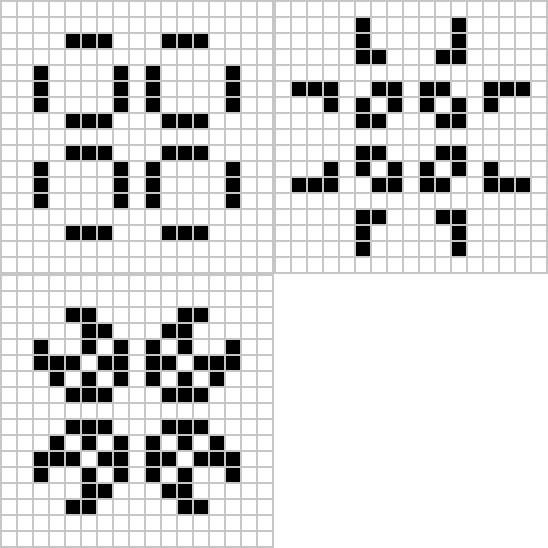
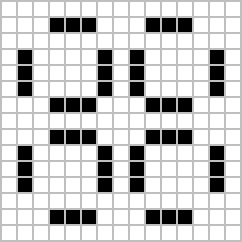
Pulsar (rarely referred to as Cambridge pulsar CP 48-56-72[note 1]) is a large but surprisingly common period 3 oscillator. It was found very early on by John Conway.
The rotor of a pulsar consists of four mutually stabilizing quadrants; alternate arrangements exist for any odd multiple of 4 (for the version with 12 copies, see quasar). A closely related oscillator — the pulsar quadrant — includes just the external "horns" of the rotor and can be stabilized on its own.
Despite its size, pulsar is the fourth most common oscillator (and the most common of period greater than 2) in Achim Flammenkamp's census; the only oscillators more common are blinker, toad, and beacon.[1] It is by far the most common period 3 oscillator, being about 45,000 times more common than jam.[2] Overall, the pulsar is the twenty-first most common object on Adam P. Goucher's Catagolue.[3]
See also
Notes
- ↑ The numbers refer to the populations of the three phases. The Life pulsar was indeed discovered at Cambridge, like the first real pulsar a few years earlier.
References
- ↑ Achim Flammenkamp (September 7, 2004). "Most seen natural occurring ash objects in Game of Life". Retrieved on January 15, 2009.
- ↑ Adam P. Goucher. "Census". Catagolue. Retrieved on October 27, 2018.
- ↑ Adam P. Goucher. "Statistics". Catagolue. Retrieved on June 24, 2016.
External links
- Pulsar at the Life Lexicon
- 48P3.6 at Heinrich Koenig's Game of Life Object Catalogs
- Patterns
- Patterns with Catagolue frequency class 12
- Natural periodic objects
- Oscillators with 48 cells
- Periodic objects with minimum population 48
- Patterns with 48 cells
- Patterns found by John Conway
- Patterns found in 1970
- Patterns that can be constructed with 3 gliders
- Oscillators
- Oscillators with period 3
- Oscillators with mod 3
- Oscillators with heat 42
- Oscillators with volatility 0.73
- Oscillators with strict volatility 0.73
- Oscillators with rotor Pulsar
- Patterns with complete square symmetry
- Sparkers
- Weak sparkers
- Sparkers with period 3