Spark coil: Difference between revisions
Haycat2009 (talk | contribs) m Add p6 domino fountain |
No edit summary |
||
| Line 33: | Line 33: | ||
{{EmbedViewer | {{EmbedViewer | ||
|rle = x = | |rle = x = 37, y = 24, rule = B3/S23 | ||
20b2o2$16bo8bo$15b2o8b2o$15b2o8b2o$18b6o$13bo14bo$12b4o10b4o$11bo3bo10b | |||
$ | o3bo$12b3o12b3o2$bo34bo$obo4bo4b3o3b2o7b3o4b3o$bobo2bobo2bobobobo2bo2b | ||
o2bobobo2bo$3bo2bobo2b2ob2obo2b4o2b2ob2o2bob2o$bobo2bobo2bobobobo2bo2b | |||
o2bobobo2bo2bo$obo4bo4b3o3b2o7b3o4b2o$bo2$12b3o12b3o$11bo3bo10bo3bo$11b | |||
obobo10b2ob2o$12bobo$13bo! | |||
|position = center | |position = center | ||
|caption = Several ways to extend a spark coil and terminate it, using a [[honeycombinator]], [[G (induction coil)|G]], [[house]], [[scrubber]], [[piston]], [[Line of three]], [[phi spark]], [[snake]] and [[p6 domino fountain]]. | |caption = Several ways to extend a spark coil and terminate it, using a [[honeycombinator]], [[G (induction coil)|G]], [[house]], [[scrubber]], [[piston]], [[Line of three]], [[phi spark]], [[snake]] and [[p6 domino fountain]]. | ||
Revision as of 17:49, 29 January 2024
| Spark coil | |||||||||
| View animated image | |||||||||
| View static image | |||||||||
| Pattern type | Oscillator | ||||||||
|---|---|---|---|---|---|---|---|---|---|
| Oscillator type | Babbling brook | ||||||||
| Number of cells | 18 | ||||||||
| Bounding box | 8 × 5 | ||||||||
| Frequency class | 24.0 | ||||||||
| Period | 2 (mod: 2) | ||||||||
| Heat | 2 | ||||||||
| Volatility | 0.10 | 0.10 | ||||||||
| Kinetic symmetry | Unspecified | ||||||||
| Rotor type | Orthogonal on-off | ||||||||
| Discovered by | Unknown | ||||||||
| Year of discovery | 1971 | ||||||||
| |||||||||
| |||||||||
| |||||||||
| |||||||||

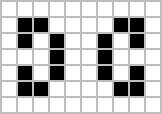
The spark coil is a period-2 oscillator found in 1971.[1][2] Despite its name, it does not produce sparks; however, the rotor resembles an electric spark.
Welded together with minimal separating stators, it can be extended indefinitely along its axis, so that it is the first in a series that continues with the piston and the long piston. It can also be arranged in two directions, as shown at Agar#Tile_agars.
One or both of the houses can be replaced with other induction coils containing a line of three.
| Several ways to extend a spark coil and terminate it, using a honeycombinator, G, house, scrubber, piston, Line of three, phi spark, snake and p6 domino fountain. (click above to open LifeViewer) |
Commonness
- Main article: List of common oscillators
Spark coil is the eleventh most common naturally-occurring oscillator in Achim Flammenkamp's census, being less common than the figure eight but more common than the mold.[3] It is the eleventh most common oscillator on Adam P. Goucher's Catagolue.
In even orthogonal symmetries (D2_+2, D4_+2, D4_+4, D8_4), it is the sixteenth to twentieth most common object, fourth to sixth most common oscillator, and fourth most common period-2 oscillator.
Glider synthesis
Spark coil can be very simply synthesised in four gliders via two colliding pi-heptominoes, which take two gliders each.
See also
References
- ↑ Robert Wainwright (September 1971). Lifeline, vol 3, page 3.
- ↑ Dean Hickerson's oscillator stamp collection. Retrieved on March 14, 2020.
- ↑ Achim Flammenkamp (September 7, 2004). "Most seen natural occurring ash objects in Game of Life". Retrieved on January 15, 2009.
External links
- Spark coil at the Life Lexicon
- Spark coil at Adam P. Goucher's Catagolue
- 18P2.28 at Heinrich Koenig's Game of Life Object Catalogs
- Patterns
- Patterns with Catagolue frequency class 24
- Natural periodic objects
- Oscillators with 18 cells
- Periodic objects with minimum population 18
- Patterns with 18 cells
- Patterns found in 1971
- Patterns that can be constructed with 4 gliders
- Oscillators
- Babbling brooks
- Oscillators with period 2
- Oscillators with mod 2
- Oscillators with heat 2
- Oscillators with volatility 0.10
- Oscillators with strict volatility 0.10
- Oscillators with rotor Orthogonal on-off
- Patterns with rectangular orthogonal symmetry