Trans-barge with tail
| Trans-barge with tail | |||||||||
| View static image | |||||||||
| Pattern type | Strict still life | ||||||||
|---|---|---|---|---|---|---|---|---|---|
| Number of cells | 10 | ||||||||
| Bounding box | 6 × 6 | ||||||||
| Frequency class | 21.5 | ||||||||
| Static symmetry | n (C1) | ||||||||
| Discovered by | Unknown | ||||||||
| Year of discovery | 1972 | ||||||||
| |||||||||
| |||||||||
| |||||||||
| |||||||||
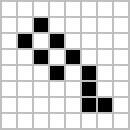
Trans-barge with tail is a 10-cell still life.
This still life is comprised of the normally stable barge with a normally unstable tail attached. This is one of two possible isomers, named trans due to the far end of the barge facing outwards from the tail; the other isomer, cis-barge with tail, has the far end tucked inwards.
Occurrence
Trans-barge with tail is the eighty-fourth most common still life in Achim Flammenkamp's census, being less common than snorkel loop, but more common than beehive on cap.[1]
It is the 86th most common still life on Adam P. Goucher's Catagolue, being less common than cis-boat on table but more common than trans-boat on dock. It is the 12th most common still life with 10 cells, being less common than claw with tail but more common than very long barge.[2]
It makes a brief appearance at generation 6155 of the methuselah Ed.
Glider synthesis
- Main article: Glider synthesis
On April 13, 2007 Dean Hickerson found a 4-glider synthesis of this still life.[3]
See also
References
- ↑ Achim Flammenkamp (September 7, 2004). "Most seen natural occurring ash objects in Game of Life". Retrieved on November 3, 2009.
- ↑ Adam P. Goucher. "Statistics". Catagolue. Retrieved on May 4, 2023.
- ↑ Dean Hickerson's 2, 3, and 4-glider syntheses pattern collection
External links
- The 25 ten-bit still-lifes at Mark D. Niemiec's Life Page
- Patterns
- Patterns with Catagolue frequency class 21
- Natural periodic objects
- Periodic objects with minimum population 10
- Patterns with 10 cells
- Patterns found in 1972
- Patterns that can be constructed with 4 gliders
- Still lifes
- Strict still lifes
- Strict still lifes with 10 cells
- Strict still lifes with n symmetry