Bracket pulsar
| Bracket pulsar | |||||||||
| View static image | |||||||||
| Pattern type | Oscillator | ||||||||
|---|---|---|---|---|---|---|---|---|---|
| Number of cells | 48 | ||||||||
| Bounding box | 15 × 15 | ||||||||
| Period | 3 (mod: 3) | ||||||||
| Heat | 53.3 | ||||||||
| Volatility | 0.91 | 0.91 | ||||||||
| Kinetic symmetry | Unspecified | ||||||||
| Discovered by | Hartmut Holzwart | ||||||||
| Year of discovery | 1993 | ||||||||
| |||||||||
| |||||||||
| |||||||||
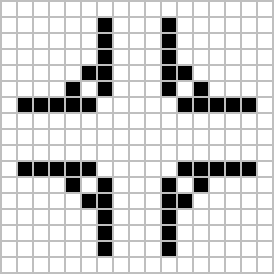
Bracket pulsar[notes 1] is a period-3 oscillator discovered by Hartmut Holzwart on the 5th of March, 1993.[1] Despite being identical in population and bounding box to the pulsar, it is much rarer, having never appeared naturally so far.
It is one of three notable extensible families of p3 oscillators with D8 symmetry, the others being the pulsar and the cross. Its next extension is the bracket quasar, named in analogy to the quasar.
Notes
- ↑ named as such on Catagolue
References
- ↑ Dean Hickerson's oscillator stamp collection. Retrieved on 14 December 2021.
External links
- 48P3.12 at Heinrich Koenig's Game of Life Object Catalogs
Categories:
- Patterns
- Oscillators with 48 cells
- Periodic objects with minimum population 48
- Patterns with 48 cells
- Patterns found by Hartmut Holzwart
- Patterns found in 1993
- Oscillators
- Oscillators with period 3
- Oscillators with mod 3
- Oscillators with heat 53
- Oscillators with volatility 0.91
- Oscillators with strict volatility 0.91
- Semi-natural periodic objects
- Patterns with complete square symmetry