Dinner table
| Dinner table | |||||||||
| View animated image | |||||||||
| View static image | |||||||||
| Pattern type | Oscillator | ||||||||
|---|---|---|---|---|---|---|---|---|---|
| Number of cells | 33 | ||||||||
| Bounding box | 13 × 13 | ||||||||
| Period | 12 (mod: 3) | ||||||||
| Heat | 10.0 | ||||||||
| Volatility | 0.55 | 0.53 | ||||||||
| Kinetic symmetry | Unspecified | ||||||||
| Discovered by | Robert Wainwright | ||||||||
| Year of discovery | 1972 | ||||||||
| |||||||||
| |||||||||
| |||||||||
| |||||||||
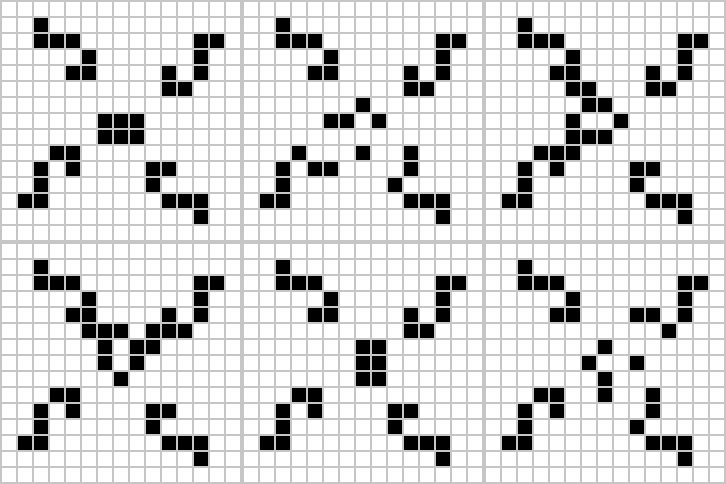
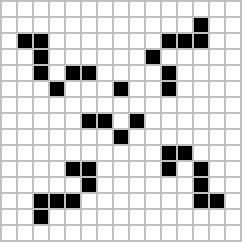
Dinner table is a period-12 oscillator. It was the first period 12 oscillator to be found, and was discovered by Robert Wainwright in 1972.[1] It consists of four eater 1s hassling a pre-beehive. In terms of its minimum population of 33 cells, it is the smallest known non-trivial period 12 oscillator, although the trivial mold on long hook eating tub contains only 24 cells.[2] It can also be extended as an agar.
Image gallery
 |
 RLE: here |
See also
References
- ↑ Dean Hickerson's oscillator stamp collection.
- ↑ "Class 2 Objects Catalog". Retrieved on April 9, 2009.
External links
- Dinner table at the Life Lexicon
- 33P12.1 at Heinrich Koenig's Game of Life Object Catalogs
Categories:
- Patterns
- Oscillators with 33 cells
- Periodic objects with minimum population 33
- Patterns with 33 cells
- Patterns found by Robert Wainwright
- Patterns found in 1972
- Patterns that can be constructed with 19 gliders
- Oscillators
- Oscillators with period 12
- Oscillators with mod 3
- Oscillators with heat 10
- Oscillators with volatility 0.55
- Oscillators with strict volatility 0.53
- Non-flipping oscillators that turn 90 degrees