Paperclip
| Paperclip | |||||||||
| View static image | |||||||||
| Pattern type | Strict still life | ||||||||
|---|---|---|---|---|---|---|---|---|---|
| Number of cells | 14 | ||||||||
| Bounding box | 5 × 6 | ||||||||
| Frequency class | 12.8 | ||||||||
| Static symmetry | Unspecified | ||||||||
| Discovered by | Unknown | ||||||||
| Year of discovery | Unknown | ||||||||
| |||||||||
| |||||||||
| |||||||||
| |||||||||
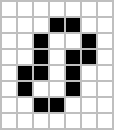
Paperclip (or drain trap[1] or S[2]) is a 14-bit still life.
It contains a photonegative Z-hexomino.
Paperclip is the sixteenth most common still life in Achim Flammenkamp's census, being less common than aircraft carrier but more common than long ship.[3]. It is also the twenty-second most common object on Adam P. Goucher's Catagolue.[4]
Because it usually forms from specific predecessors, the difference in frequency in asymmetric soups compared to C2_2 (the symmetry the object has) is small, although not negligible. Similarly, in rules that support the object but not its predecessors, such as HighLife, it is much less common.
See also
References
- ↑ "Drain trap". The Life Lexicon. Stephen Silver. Retrieved on May 2, 2009.
- ↑ "S". The Life Lexicon. Stephen Silver. Retrieved on May 2, 2009.
- ↑ Achim Flammenkamp (September 7, 2004). "Most seen natural occurring ash objects in Game of Life". Retrieved on January 15, 2009.
- ↑ Adam P. Goucher. "Statistics". Catagolue. Retrieved on June 24, 2016.
External links
- Paperclip at the Life Lexicon
- The 619 fourteen-bit still-lifes at Mark D. Niemiec's Life Page