Carnival shuttle: Difference between revisions
p3 pipsquirter stabilization |
|||
| Line 39: | Line 39: | ||
* A [[beehive]] can be placed in between. | * A [[beehive]] can be placed in between. | ||
Shuttles can also hassle a [[beehive]]-[[traffic light]]-[[loaf]] component. The shuttle can be stabilised by monograms, [[middleweight emulator]]s, [[T-nosed p4]]s, and a stable [[beehive push]] | Shuttles can also hassle a [[beehive]]-[[traffic light]]-[[loaf]] component. The shuttle can be stabilised by monograms, [[middleweight emulator]]s, [[T-nosed p4]]s, and a stable [[beehive push catalyst]] by [[Tanner Jacobi]].<ref name="post116491" /><ref name="post116533" /> The [[Blocked p4-3]] gives the same spark, and thus can be used as a stabilizer too. | ||
Without stabilizations on the ends, a spatial period 12 wick can be constructed. A finite version requires the addition of stabilizations as caps. | Without stabilizations on the ends, a spatial period 12 wick can be constructed. A finite version requires the addition of stabilizations as caps. | ||
Revision as of 17:42, 23 October 2021
| Carnival shuttle | |||||||||
| View animated image | |||||||||
| View static image | |||||||||
| Pattern type | Oscillator | ||||||||
|---|---|---|---|---|---|---|---|---|---|
| Oscillator type | Shuttle | ||||||||
| Number of cells | 43 | ||||||||
| Bounding box | 24 × 7 | ||||||||
| Period | 12 (mod: 6) | ||||||||
| Heat | 38 | ||||||||
| Volatility | 0.91 | 0.27 | ||||||||
| Kinetic symmetry | Unspecified | ||||||||
| Discovered by | Robert Wainwright | ||||||||
| Year of discovery | 1984 | ||||||||
| |||||||||
| |||||||||
| |||||||||
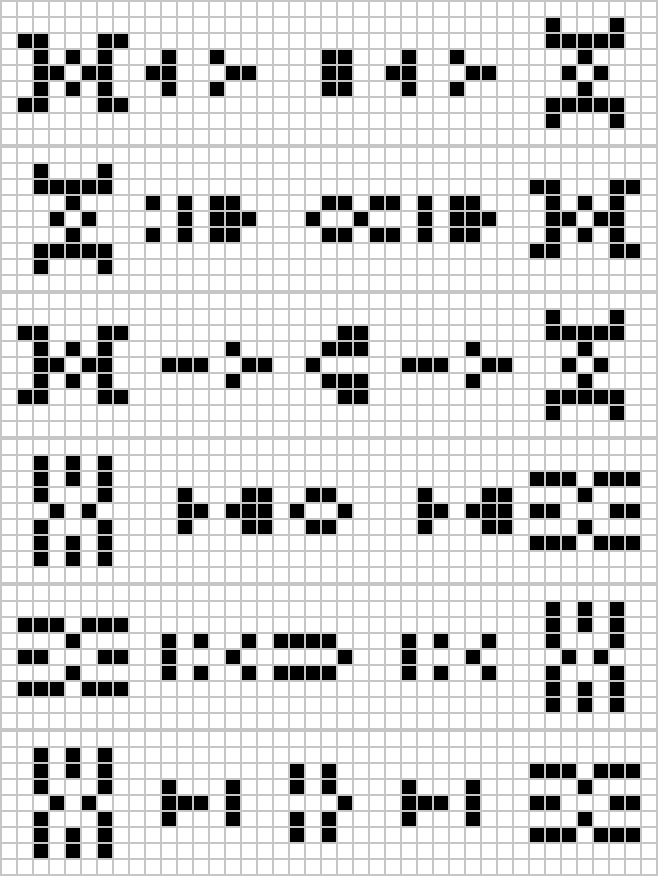
Carnival shuttle is a period-12 oscillator that was found by Robert Wainwright in September 1984 (using middleweight emulators at the end, instead of the monograms shown here).[1] It was used to create the first known non-trivial period 24 oscillator, 186P24.
The shuttle itself is a reaction between two t-tetrominos. Its stability requires the suppression of one birth per period at both ends of the shuttle. This is normally done with period-4 oscillators, although 83bismuth38 found in 2021 that the newly discovered p3 pipsquirters could also provide the necessary spark.[2]
There are many ways to stabilise adjacent shuttles:
| (click above to open LifeViewer) RLE: here Plaintext: here |
Shuttles can also hassle a beehive-traffic light-loaf component. The shuttle can be stabilised by monograms, middleweight emulators, T-nosed p4s, and a stable beehive push catalyst by Tanner Jacobi.[3][4] The Blocked p4-3 gives the same spark, and thus can be used as a stabilizer too.
Without stabilizations on the ends, a spatial period 12 wick can be constructed. A finite version requires the addition of stabilizations as caps.
References
- ↑ Dean Hickerson's oscillator stamp collection. Retrieved on March 14, 2020.
- ↑ 83bismuth38 (October 22, 2021). Re: Oscillator Discussion Thread (discussion thread) at the ConwayLife.com forums
- ↑ Tanner Jacobi (December 20, 2020). Re: Results of catalyst tests (discussion thread) at the ConwayLife.com forums
- ↑ Aidan F. Pierce (December 20, 2020). Re: Oscillator Discussion Thread (discussion thread) at the ConwayLife.com forums
External links
- Carnival shuttle at the Life Lexicon
- 43P12.1 at Heinrich Koenig's Game of Life Object Catalogs
- Patterns
- Oscillators with 43 cells
- Periodic objects with minimum population 43
- Patterns with 43 cells
- Patterns found by Robert Wainwright
- Patterns found in 1984
- Oscillators
- Shuttles
- Oscillators with period 12
- Oscillators with mod 6
- Oscillators with heat 38
- Oscillators with volatility 0.91
- Oscillators with strict volatility 0.27
- Patterns with bilateral orthogonal symmetry
- Flipping oscillators