Pulsar: Difference between revisions
Jump to navigation
Jump to search
m Added bounding box |
m added quasar see also |
||
| Line 6: | Line 6: | ||
*[[Pre-pulsar]] | *[[Pre-pulsar]] | ||
*[[Pulsar quadrant]] | *[[Pulsar quadrant]] | ||
*[[Quasar]] | |||
==References== | ==References== | ||
Revision as of 03:53, 19 February 2009
| Pulsar | |||||||
| View animated image | |||||||
| View static image | |||||||
| Pattern type | Oscillator | ||||||
|---|---|---|---|---|---|---|---|
| Number of cells | 48 | ||||||
| Bounding box | 15 × 15 | ||||||
| Period | 3 (mod: Unknown) | ||||||
| Heat | 42.7 | ||||||
| Volatility | Unknown | Unknown | ||||||
| Kinetic symmetry | Unspecified | ||||||
| Discovered by | John Conway | ||||||
| Year of discovery | Unknown | ||||||
| |||||||
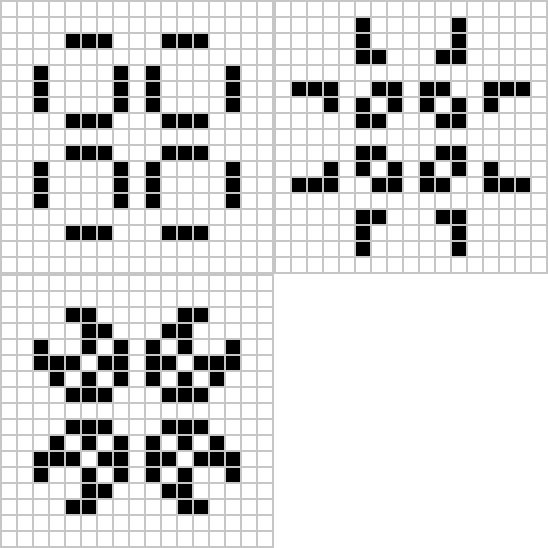

Pulsar is, despite its size, the fourth most common oscillator (and by far the most common of period greater than 2). The three more common oscillators are blinker, toad, and beacon.[1] Pulsar was found very early on by John Conway.
See also
References
- ↑ Achim Flammenkamp (September 7, 2004). "Most seen natural occurring ash objects in Game of Life". Retrieved on January 15, 2009.
External links
Pulsar at the Life Lexicon