Diamondback: Difference between revisions
Jump to navigation
Jump to search
No edit summary |
No edit summary |
||
| Line 24: | Line 24: | ||
'''Diamondback''' is a {{period|11}} [[oscillator]] found by [[Nico Brown]] in a symmetric [[CatForce]] search and [[monomer]]ised on November 8, {{year|2022}}.<ref name="post153284" /> In terms of its {{cells|33|text=33 cells}}, it is currently tied for the smallest known period 11 oscillator with [[rattlesnake]]. Its name comes from its similarity to [[rattlesnake]], which was named for having 11 letters and a [[snake]] [[motif]]; a diamondback is another type of snake (despite the lack of a snake in the oscillator), and diamondback also has 11 letters. In addition, both diamondback and rattlesnake are mostly [[stator]] with a small active area. Unlike rattlesnake, diamondback doesn't give off [[spark]]s. However, it can perform the [[toad reaction|same reaction]] as a singular [[killer toads|killer toad]] at p11, such as converting an [[octomino II]] to a [[glider]]. | '''Diamondback''' is a {{period|11}} [[oscillator]] found by [[Nico Brown]] in a symmetric [[CatForce]] search and [[monomer]]ised on November 8, {{year|2022}}.<ref name="post153284" /> In terms of its {{cells|33|text=33 cells}}, it is currently tied for the smallest known period 11 oscillator with [[rattlesnake]]. Its name comes from its similarity to [[rattlesnake]], which was named for having 11 letters and a [[snake]] [[motif]]; a diamondback is another type of snake (despite the lack of a snake in the oscillator), and diamondback also has 11 letters. In addition, both diamondback and rattlesnake are mostly [[stator]] with a small active area. Unlike rattlesnake, diamondback doesn't give off [[spark]]s. However, it can perform the [[toad reaction|same reaction]] as a singular [[killer toads|killer toad]] at p11, such as converting an [[octomino II]] to a [[glider]]. | ||
==References== | == References == | ||
<references> | <references> | ||
<ref name="post153284">{{LinkForumThread | <ref name="post153284">{{LinkForumThread | ||
| Line 35: | Line 35: | ||
</references> | </references> | ||
==External links== | == External links == | ||
* {{LinkCatagolue|xp11_08k8wg8e13zy13d115b8ozc453}} | * {{LinkCatagolue|xp11_08k8wg8e13zy13d115b8ozc453}} | ||
* {{LinkWikipedia|Western_diamondback_rattlesnake|name=Diamondback (the actual snake)}} | * {{LinkWikipedia|Western_diamondback_rattlesnake|name=Diamondback (the actual snake)}} | ||
Revision as of 20:04, 7 August 2024
| Diamondback | |||||||||
| View static image | |||||||||
| Pattern type | Oscillator | ||||||||
|---|---|---|---|---|---|---|---|---|---|
| Number of cells | 33 | ||||||||
| Bounding box | 13 × 14 | ||||||||
| Period | 11 (mod: 11) | ||||||||
| Heat | 6.9 | ||||||||
| Volatility | 0.54 | 0.54 | ||||||||
| Kinetic symmetry | n | ||||||||
| Discovered by | Nico Brown | ||||||||
| Year of discovery | 2022 | ||||||||
| |||||||||
| |||||||||
| |||||||||
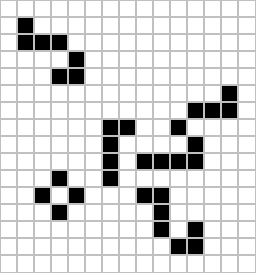
Diamondback is a period-11 oscillator found by Nico Brown in a symmetric CatForce search and monomerised on November 8, 2022.[1] In terms of its 33 cells, it is currently tied for the smallest known period 11 oscillator with rattlesnake. Its name comes from its similarity to rattlesnake, which was named for having 11 letters and a snake motif; a diamondback is another type of snake (despite the lack of a snake in the oscillator), and diamondback also has 11 letters. In addition, both diamondback and rattlesnake are mostly stator with a small active area. Unlike rattlesnake, diamondback doesn't give off sparks. However, it can perform the same reaction as a singular killer toad at p11, such as converting an octomino II to a glider.
References
- ↑ iNoMed (November 8, 2022). Re: Oscillator Discussion Thread (discussion thread) at the ConwayLife.com forums
External links
- Diamondback at Adam P. Goucher's Catagolue
- Diamondback (the actual snake) at Wikipedia
Categories:
- Patterns
- Oscillators with 33 cells
- Periodic objects with minimum population 33
- Patterns with 33 cells
- Patterns found by Nico Brown
- Patterns found in 2022
- Oscillators
- Oscillators with period 11
- Prime-period oscillators
- Oscillators with mod 11
- Oscillators with heat 6
- Oscillators with volatility 0.54
- Oscillators with strict volatility 0.54
- Oscillators with n symmetry