Gemini: Difference between revisions
No edit summary |
.zip pattern file |
||
| Line 14: | Line 14: | ||
|rulemax = B3/S23 | |rulemax = B3/S23 | ||
|rulespecial = [[Conway's Game of Life|Conway Life]] | |rulespecial = [[Conway's Game of Life|Conway Life]] | ||
| | |zip = true | ||
}} | }} | ||
'''Gemini''' is the first [[oblique spaceship]] to be constructed, and was created by [[Andrew J. Wade]] in 2010.<ref>{{cite web|url=http://pentadecathlon.com/lifeNews/2010/05/oblique_life_spaceship_created.html|title=Oblique Life spaceship created|date=May 19, 2010|work=Game of Life News|author=Adam P. Goucher|accessdate=May 21, 2010}}</ref> It displaces itself by 5120 cells vertically and 1024 cells horizontally every 33,699,586 generations. It derives its name from the latin, ''gemini'', meaning twins, describing its 2 identical halves, each of which contains three [[Chapman-Greene construction arm]]s. A ''tape'' of gliders continually relays between the two halves, instructing each to delete its parent and construct a daughter configuration. | '''Gemini''' is the first [[oblique spaceship]] to be constructed, and was created by [[Andrew J. Wade]] in 2010.<ref>{{cite web|url=http://pentadecathlon.com/lifeNews/2010/05/oblique_life_spaceship_created.html|title=Oblique Life spaceship created|date=May 19, 2010|work=Game of Life News|author=Adam P. Goucher|accessdate=May 21, 2010}}</ref> It displaces itself by 5120 cells vertically and 1024 cells horizontally every 33,699,586 generations. It derives its name from the latin, ''gemini'', meaning twins, describing its 2 identical halves, each of which contains three [[Chapman-Greene construction arm]]s. A ''tape'' of gliders continually relays between the two halves, instructing each to delete its parent and construct a daughter configuration. | ||
Revision as of 22:35, 11 August 2016
| Gemini | |||||||
| |||||||
| View static image | |||||||
| Pattern type | Spaceship | ||||||
|---|---|---|---|---|---|---|---|
| Number of cells | 846278 | ||||||
| Bounding box | 4217807 × 4220191 | ||||||
| Direction | Oblique | ||||||
| Slope | 5 | ||||||
| Period | 33699586 (mod: Unknown) | ||||||
| Speed | 2560c/16849793 | Unknown | ||||||
| Heat | Unknown | ||||||
| Kinetic symmetry | Unspecified | ||||||
| Discovered by | Andrew J. Wade | ||||||
| Year of discovery | 2010 | ||||||
| |||||||
| |||||||

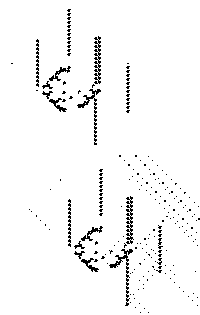
Gemini is the first oblique spaceship to be constructed, and was created by Andrew J. Wade in 2010.[1] It displaces itself by 5120 cells vertically and 1024 cells horizontally every 33,699,586 generations. It derives its name from the latin, gemini, meaning twins, describing its 2 identical halves, each of which contains three Chapman-Greene construction arms. A tape of gliders continually relays between the two halves, instructing each to delete its parent and construct a daughter configuration.
It is the largest spaceship in terms of its diameter and bounding box, but has a much smaller population than the Caterpillar.
The pattern marks the thirteenth explicitly-constructed spaceship velocity, but facilitates an infinite range of related velocities. For example, Dave Greene has reduced its period by eight generations, whilst maintaining its displacement. Theoretically speaking, a Gemini-esque spaceship could be constructed with any velocity slower than (but not equal to) (1,1)c/580[2].
Videos
Pattern files
See Also
References
- ↑ Adam P. Goucher (May 19, 2010). "Oblique Life spaceship created". Game of Life News. Retrieved on May 21, 2010.
- ↑ "Universal Constructor Based Spaceship". Retrieved on May 21, 2010.
External links
- New Scientist: First replicating creature spawned in life simulator
- downloadable zip of the Gemini RLE file (Google is not allowing to download the file, but you can Share->Email as attachment to yourself)
- Gemini RLE file with programs used to construct it (on Google docs so download quota may be exceeded by the time you attempt download.)
- Gemini RLE file with programs used to construct it (alternate download on drop.io)
- Patterns
- Spaceships with between 100,000 and 999,999 cells
- Periodic objects with minimum population between 100,000 and 999,999
- Patterns with between 100,000 and 999,999 cells
- Patterns found by Andrew J. Wade
- Patterns found in 2010
- Outer-totalistically endemic patterns
- Spaceships
- Spaceships with period 33699586
- Oblique spaceships
- Spaceships with slope 5
- Spaceships with speed 2560c/16849793
- Universal constructors
- Engineerable spaceships
- Spaceships with slope 2
- Spaceships with slope 3