Hat: Difference between revisions
Jump to navigation
Jump to search
eater |
Apple Bottom (talk | contribs) m LinkCatagolue + LinkNiemiec |
||
| Line 15: | Line 15: | ||
{{LinkWeisstein|Hat.html}} | {{LinkWeisstein|Hat.html}} | ||
{{LinkLexicon|lex_h.htm#hat}} | {{LinkLexicon|lex_h.htm#hat}} | ||
{{LinkCatagolue|xs9_4aar}} | |||
{{LinkNiemiec|p1.htm#p1-9|patternname=The 10 nine-bit still-lifes}} | |||
[[Category:Patterns with bilateral symmetry]] | [[Category:Patterns with bilateral symmetry]] | ||
[[Category:Eaters]] | [[Category:Eaters]] | ||
Revision as of 12:36, 21 March 2016
| Hat | |||||||
| View static image | |||||||
| Pattern type | Strict still life | ||||||
|---|---|---|---|---|---|---|---|
| Number of cells | 9 | ||||||
| Bounding box | 5 × 4 | ||||||
| Static symmetry | Unspecified | ||||||
| Discovered by | Unknown | ||||||
| Year of discovery | 1971 | ||||||
| |||||||
| |||||||
| |||||||
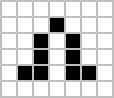
Hat is the twenty-fifth most common still life, being less common than trans-boat with tail but more common than boat-ship-tie.[1] It was discovered independently in 1971 by several Life enthusiasts and named by Charles Corderman.[2]
The hat (as well as similar still lifes such as table on table) can be used as an eater (in particular, a rock) stabilizing the twin bees shuttle. The mechanism has some similarities to snake-type eaters.
See also
References
- ↑ Achim Flammenkamp (September 7, 2004). "Most seen natural occurring ash objects in Game of Life". Retrieved on January 15, 2009.
- ↑ Robert Wainwright (June 1971). "Lifeline Volume 2".
External links
- Hat at the Life Lexicon
- Hat at Adam P. Goucher's Catagolue
- The 10 nine-bit still-lifes at Mark D. Niemiec's Life Page