Dinner table: Difference between revisions
Jump to navigation
Jump to search
added Lifeline ref |
cleanup/formatting |
||
| Line 21: | Line 21: | ||
|rle = true | |rle = true | ||
|animated = yes | |animated = yes | ||
|viewerconfig = #C [[ GPS 4 LOOP 12 | |viewerconfig = #C [[ HEIGHT 500 THUMBSIZE 3 ZOOM 24 GPS 4 LOOP 12 ]] | ||
|apgcode = xp12_032acy0oge2z0g8ow77ggz23y21226 | |apgcode = xp12_032acy0oge2z0g8ow77ggz23y21226 | ||
|pentadecathlonid = 33P12.1 | |pentadecathlonid = 33P12.1 | ||
}} | }} | ||
'''Dinner table''' is a {{period|12}} [[oscillator]]. It was the first period 12 oscillator to be found, and was discovered by [[Robert Wainwright]] in {{year|1972}}.<ref>{{CiteLifeline|vol=6|pages=page 3}}</ref><ref>{{CiteHickersonOscillators}}</ref> It consists of four [[eater 1]]s [[hassle|hassling]] a [[pre-beehive | '''Dinner table''' is a {{period|12}} [[oscillator]]. It was the first period 12 oscillator to be found, and was discovered by [[Robert Wainwright]] in {{year|1972}}.<ref>{{CiteLifeline|vol=6|pages=page 3}}</ref><ref>{{CiteHickersonOscillators}}</ref> It consists of four [[eater 1]]s [[hassle|hassling]] a [[pre-beehive]]. | ||
[[Image:dinnertable_gen1.png|framed|center|Generation 1 reveals that the object being hassled is a pre-beehive]] | |||
In terms of its minimum population of {{cells|33|text=33 cells}}, it is the smallest known non-trivial period 12 oscillator, although the trivial [[mold on long hook eating tub]] contains only {{cells|24|text=24 cells}}.<ref>{{cite web|url=http://pentadecathlon.com/objects/class2/class2.php?part=1 |title=Class 2 Objects Catalog |accessdate=April 9, 2009}}</ref> It can also be extended as an [[agar]]. | |||
|{{EmbedViewer | {{EmbedViewer | ||
|pname = dinnertableextended | |pname = dinnertableextended | ||
|viewerconfig = #C [[ HEIGHT 600 THUMBSIZE 2 ZOOM 14 AUTOSTART GPS 4 LOOP 12 ]] | |||
|position = center | |position = center | ||
|caption = An extension of dinner table | |||
|caption = An extension of dinner table | |style = width:300px; | ||
}} | }} | ||
==See also== | ==See also== | ||
*[[Four eaters hassling lumps of muck]] | * [[Four eaters hassling lumps of muck]] | ||
*[[Roteightor]] | * [[Roteightor]] | ||
==References== | ==References== | ||
| Line 47: | Line 47: | ||
==External links== | ==External links== | ||
{{LinkLexicon|lex_d.htm#dinnertable}} | * {{LinkLexicon|lex_d.htm#dinnertable}} | ||
{{LinkCatagolue|xp12_032acy0oge2z0g8ow77ggz23y21226}} | * {{LinkCatagolue|xp12_032acy0oge2z0g8ow77ggz23y21226}} | ||
{{LinkPentadecathlonObject|33P12.1}} | * {{LinkPentadecathlonObject|33P12.1}} | ||
{{Symmetry|osc=turn90}} | {{Symmetry|osc=turn90}} | ||
__NOTOC__ | __NOTOC__ | ||
Revision as of 18:19, 18 May 2023
| Dinner table | |||||||||
| View animated image | |||||||||
| View static image | |||||||||
| Pattern type | Oscillator | ||||||||
|---|---|---|---|---|---|---|---|---|---|
| Number of cells | 33 | ||||||||
| Bounding box | 13 × 13 | ||||||||
| Period | 12 (mod: 3) | ||||||||
| Heat | 10.0 | ||||||||
| Volatility | 0.55 | 0.53 | ||||||||
| Kinetic symmetry | Unspecified | ||||||||
| Discovered by | Robert Wainwright | ||||||||
| Year of discovery | 1972 | ||||||||
| |||||||||
| |||||||||
| |||||||||
| |||||||||
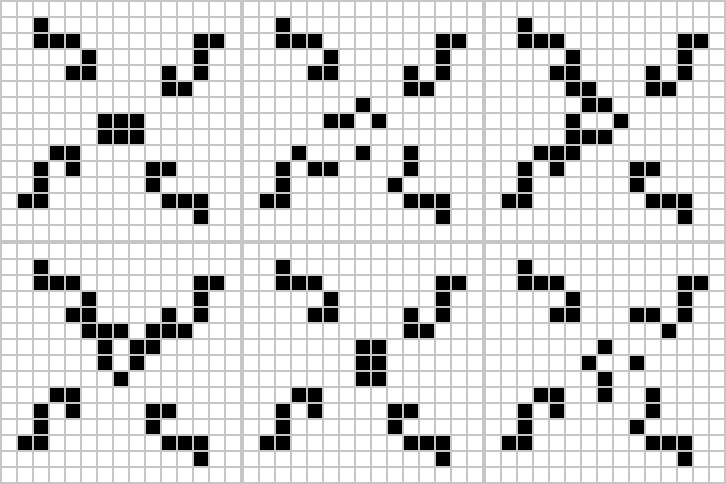
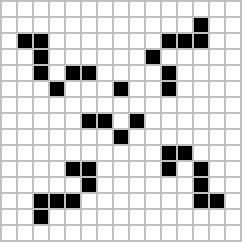
Dinner table is a period-12 oscillator. It was the first period 12 oscillator to be found, and was discovered by Robert Wainwright in 1972.[1][2] It consists of four eater 1s hassling a pre-beehive.

In terms of its minimum population of 33 cells, it is the smallest known non-trivial period 12 oscillator, although the trivial mold on long hook eating tub contains only 24 cells.[3] It can also be extended as an agar.
| An extension of dinner table (click above to open LifeViewer) RLE: here Plaintext: here |
See also
References
- ↑ Robert Wainwright (October 1972). Lifeline, vol 6, page 3.
- ↑ Dean Hickerson's oscillator stamp collection.
- ↑ "Class 2 Objects Catalog". Retrieved on April 9, 2009.
External links
- Dinner table at the Life Lexicon
- Dinner table at Adam P. Goucher's Catagolue
- 33P12.1 at Heinrich Koenig's Game of Life Object Catalogs
Categories:
- Patterns
- Oscillators with 33 cells
- Periodic objects with minimum population 33
- Patterns with 33 cells
- Patterns found by Robert Wainwright
- Patterns found in 1972
- Patterns that can be constructed with 19 gliders
- Oscillators
- Oscillators with period 12
- Oscillators with mod 3
- Oscillators with heat 10
- Oscillators with volatility 0.55
- Oscillators with strict volatility 0.53
- Non-flipping oscillators that turn 90 degrees