Phoenix 1: Difference between revisions
mNo edit summary |
Neocaridina (talk | contribs) No edit summary |
||
| (19 intermediate revisions by 8 users not shown) | |||
| Line 11: | Line 11: | ||
|h = 24 | |h = 24 | ||
|v = 1.00 | |v = 1.00 | ||
|symmetry = rk*k | |||
|rotor = Flutter | |rotor = Flutter | ||
|discoverer = MIT group | |discoverer = MIT group | ||
| Line 16: | Line 17: | ||
|rulemin = B3/S | |rulemin = B3/S | ||
|rulemax = B345678/S2345678 | |rulemax = B345678/S2345678 | ||
|isorulemin = B3nqr/S | |isorulemin = B3nqr/S | ||
|isorulemax = B2ein345678/S1c2345678 | |isorulemax = B2ein345678/S1c2345678 | ||
| Line 28: | Line 28: | ||
|apgcode = xp2_882030kgz010602 | |apgcode = xp2_882030kgz010602 | ||
}}{{About|the 12-cell oscillator|the general concept|Phoenix}} | }}{{About|the 12-cell oscillator|the general concept|Phoenix}} | ||
'''Phoenix 1''' (or '''flip-flops'''<ref>{{CiteLexicon|file=lex_f.htm#flipflops|name=Flip-flops|accessdate=June 21, 2011}}</ref>) is a | '''Phoenix 1''' (or '''flip-flops'''<ref>{{CiteLexicon|file=lex_f.htm#flipflops|name=Flip-flops|accessdate=June 21, 2011}}</ref>) is a {{period|2}} [[oscillator]] that was discovered by the [[MIT group]]<ref>{{CiteHickersonOscillators|accessdate=March 14, 2020}}</ref> no later than September {{year|1971}}.<ref>{{CiteLifeline|vol=3|pages=page 3}}</ref> It is the smallest known [[phoenix]] as well as the first discovered phoenix, and is thus sometimes simply referred to as ''the'' phoenix. | ||
Phoenix 1 consists of four identical three-cell segments | Phoenix 1 consists of four identical three-cell segments [[flutter]] chained in a loop. Other arrangements are possible, to generate larger period 2 phoenices as shown below. A single copy of this rotor can also be supported by a [[stator]]: this is an oscillator known as the [[griddle]]. The same rotor segment also appears in [[by flops]] and [[why not]]. | ||
Despite its small size, it had not shown up | Despite its small size, it had not shown up [[natural]]ly in [[soup]] until October 5, 2015, making it the last {{cells|12}}-bit object to appear naturally;<ref name="post23391" /> and another soup turned up with this object on October 23.<ref name="post24121" /> Both of these soups were found by [[Tomas Rokicki]] using [[apgsearch]]. | ||
In even 90° rotational symmetry (C4_4), it is much more common, being the thirty-first most common object and the fourth most common period-2 oscillator according to [[Catagolue]]. | |||
== | == Commonness == | ||
{{main|List of common oscillators}} | |||
{{Needs occurrence info|type=oscillator}} | |||
Note that this section only concerns ''absolute'' natural occurrence - symmetric starting configurations are only counted as semi-natural. | |||
== | [[Catagolue#Contributor engagement|Catagolue]] has a dedicated badge which will be given out to anyone who discovers one. | ||
{{ | |||
{{LinkLexicon|filename=lex_p.htm#phoenix}} | == Glider synthesis == | ||
{{LinkCatagolue|xp2_882030kgz010602|patternname=Phoenix}} | [[Martin Grant]] found a {{gliders|6}} [[Glider synthesis|synthesis]] for this oscillator on March 1, {{year|2015}}, based on a symmetric reaction from [[Bob Shemyakin]].<ref name="post17343" /> | ||
{{LinkPentadecathlonObject|12P2.6}} | |||
== Extensions == | |||
Phoenix 1 is trivial to extend, yielding an infinite family of volatility-1 oscillators, some examples shown below. | |||
{{EmbedViewer | |||
|pname = p2phoenices | |||
|position = center | |||
|viewerconfig = #C [[ THUMBSIZE 2 ZOOM 8 WIDTH 700 HEIGHT 500 AUTOSTART GPS 2 LOOP 2 ]] | |||
|caption = Extensions of Phoenix 1 | |||
|style = width:300px; | |||
}} | |||
== See also == | |||
* [[Almosymmetric]] | |||
* [[Revolver]] | |||
* [[Phoenix with cavity]] | |||
== References == | |||
<references> | |||
<ref name="post23391">{{LinkForumThread | |||
|format = ref | |||
|title = Re: Soup search results | |||
|p = 23391 | |||
|author = Adam P. Goucher | |||
|date = October 5, 2015 | |||
}}</ref> | |||
<ref name="post24121">{{LinkForumThread | |||
|format = ref | |||
|title = Re: Soup search results | |||
|p = 24121 | |||
|author = Billabob | |||
|date = October 23, 2015 | |||
}}</ref> | |||
<ref name="post17343">{{LinkForumThread | |||
|format = ref | |||
|title = Re: 4 glider syntheses | |||
|p = 17343 | |||
|author = Martin Grant | |||
|date = March 1, 2015 | |||
}}</ref> | |||
</references> | |||
== External links == | |||
* {{LinkLexicon|filename=lex_p.htm#phoenix}} | |||
* {{LinkCatagolue|xp2_882030kgz010602|patternname=Phoenix}} | |||
* {{LinkNiemiec|12/12px.rle}} | |||
* {{LinkPentadecathlonObject|12P2.6}} | |||
__NOTOC__ | __NOTOC__ | ||
Latest revision as of 16:57, 21 February 2026
| Phoenix 1 | |||||||||
| View animated image | |||||||||
| View static image | |||||||||
| Pattern type | Oscillator | ||||||||
|---|---|---|---|---|---|---|---|---|---|
| Oscillator type | Phoenix | ||||||||
| Number of cells | 12 | ||||||||
| Bounding box | 8 × 8 | ||||||||
| Frequency class | 41.4 | ||||||||
| Period | 2 (mod: 1) | ||||||||
| Heat | 24 | ||||||||
| Volatility | 1.00 | 1.00 | ||||||||
| Kinetic symmetry | rk*k | ||||||||
| Rotor type | Flutter | ||||||||
| Discovered by | MIT group | ||||||||
| Year of discovery | 1971 | ||||||||
| |||||||||
| |||||||||
| |||||||||
| |||||||||
- This article is about the 12-cell oscillator. For the general concept, see Phoenix.
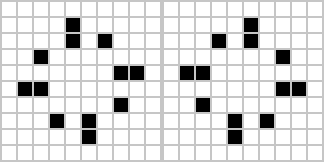
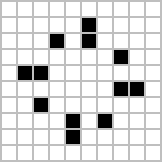
Phoenix 1 (or flip-flops[1]) is a period-2 oscillator that was discovered by the MIT group[2] no later than September 1971.[3] It is the smallest known phoenix as well as the first discovered phoenix, and is thus sometimes simply referred to as the phoenix.
Phoenix 1 consists of four identical three-cell segments flutter chained in a loop. Other arrangements are possible, to generate larger period 2 phoenices as shown below. A single copy of this rotor can also be supported by a stator: this is an oscillator known as the griddle. The same rotor segment also appears in by flops and why not.
Despite its small size, it had not shown up naturally in soup until October 5, 2015, making it the last 12-bit object to appear naturally;[4] and another soup turned up with this object on October 23.[5] Both of these soups were found by Tomas Rokicki using apgsearch.
In even 90° rotational symmetry (C4_4), it is much more common, being the thirty-first most common object and the fourth most common period-2 oscillator according to Catagolue.
Commonness
- Main article: List of common oscillators
Information on this oscillator's commonness with respect to other naturally-occurring patterns is currently unknown.
Note that this section only concerns absolute natural occurrence - symmetric starting configurations are only counted as semi-natural.
Catagolue has a dedicated badge which will be given out to anyone who discovers one.
Glider synthesis
Martin Grant found a 6-glider synthesis for this oscillator on March 1, 2015, based on a symmetric reaction from Bob Shemyakin.[6]
Extensions
Phoenix 1 is trivial to extend, yielding an infinite family of volatility-1 oscillators, some examples shown below.
| Extensions of Phoenix 1 (click above to open LifeViewer) RLE: here Plaintext: here |
See also
References
- ↑ "Flip-flops". The Life Lexicon. Stephen Silver. Retrieved on June 21, 2011.
- ↑ Dean Hickerson's oscillator stamp collection. Retrieved on March 14, 2020.
- ↑ Robert Wainwright (September 1971). Lifeline, vol 3, page 3.
- ↑ Adam P. Goucher (October 5, 2015). Re: Soup search results (discussion thread) at the ConwayLife.com forums
- ↑ Billabob (October 23, 2015). Re: Soup search results (discussion thread) at the ConwayLife.com forums
- ↑ Martin Grant (March 1, 2015). Re: 4 glider syntheses (discussion thread) at the ConwayLife.com forums
External links
- Phoenix 1 at the Life Lexicon
- Phoenix at Adam P. Goucher's Catagolue
- Phoenix 1 at Mark D. Niemiec's Life Page
- 12P2.6 at Heinrich Koenig's Game of Life Object Catalogs
- Patterns
- Patterns with Catagolue frequency class 41
- Natural periodic objects
- Oscillators with 12 cells
- Periodic objects with minimum population 12
- Patterns with 12 cells
- Patterns found by MIT group
- Patterns found in 1971
- Patterns that can be constructed with 6 gliders
- Oscillators
- Phoenices
- Oscillators with period 2
- Oscillators with mod 1
- Oscillators with heat 24
- Oscillators with volatility 1.00
- Oscillators with strict volatility 1.00
- Oscillators with rk*k symmetry
- Oscillators with rotor Flutter