Trans-ship on dock
| Trans-ship on dock | |||||||||
| View static image | |||||||||
| Pattern type | Strict still life | ||||||||
|---|---|---|---|---|---|---|---|---|---|
| Number of cells | 16 | ||||||||
| Bounding box | 6 × 7 | ||||||||
| Static symmetry | Unspecified | ||||||||
| Discovered by | Unknown | ||||||||
| Year of discovery | Unknown | ||||||||
| |||||||||
| |||||||||
| |||||||||
| |||||||||
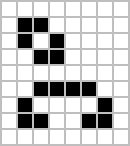
Trans-ship on dock is a 16-cell still life.
This still life is comprised of the normally stable ship acting to stabilise the normally unstable dock, an induction coil. This is one of two possible isomers, named trans due to the ship extending past the main surface of the dock; the other isomer, cis-ship on dock, does not extend out by an extra cell.
It is the 111th most common still life on Adam P. Goucher's Catagolue, and the eighth most common still life with 16 cells.
All strict still lifes with a population of 23 or fewer cells, all oscillators with 16 or fewer cells, and all spaceships with 35 or fewer cells are known to be glider-constructible. A glider synthesis of this object can be found in the infobox to the right.
See also
External links