B60
| B60 | |||||||
| View static image | |||||||
| Pattern type | Conduit | ||||||
|---|---|---|---|---|---|---|---|
| Conduit type | Elementary | ||||||
| Input | Herschel | ||||||
| Number of cells | 12 | ||||||
| Output orientation | Turned back | ||||||
| Output offset | (-6, -10) | ||||||
| Step | 60 ticks | ||||||
| Recovery time (ignoring FNG if any) |
43 ticks | ||||||
| Minimum overclock period (ignoring FNG if any) |
35 ticks | ||||||
| Spartan? | Yes | ||||||
| Dependent? | No | ||||||
| Discovered by | Michael Simkin | ||||||
| Year of discovery | 2015 | ||||||
| |||||||
| |||||||
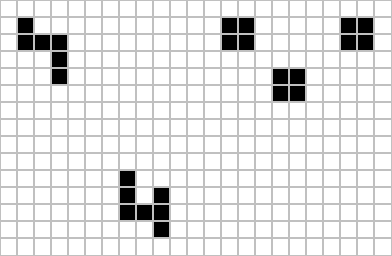
B60 is a Herschel conduit discovered by Michael Simkin in 2015 using his search program, CatForce. It is one of three known Blockic elementary conduits. After 60 ticks, it produces a Herschel rotated 180 degrees at (-6,-10) relative to the input. It can most easily be connected to another B60 conduit, producing a closed loop, the Simkin glider gun or Simkin's p60.
If the first natural glider is not removed, the FNG will obstruct the next Herschel, increasing the repeat time to 43. Assuming effective removal of the FNG, B60 can be overclocked to p35.
See also
External links
- B60 at the Life Lexicon
Categories:
- Patterns
- Patterns with 12 cells
- Patterns found by Michael Simkin
- Patterns found in 2015
- Conduits
- Elementary conduits
- Herschel conduits
- Conduits with output orientation B
- Conduits with output offset (-6, -10)
- Conduits with recovery time 43
- Conduits with minimum overclock time 35
- Spartan conduits
- Independent conduits