Ed
| Ed | |||||
| View static image | |||||
| Pattern type | Methuselah | ||||
|---|---|---|---|---|---|
| Number of cells | 151 | ||||
| Bounding box | 20 × 20 | ||||
| MCPS | 163 | ||||
| Lifespan | 30872 generations | ||||
| Final population | 2833 | ||||
| L/I | 204.5 | ||||
| F/I | 18.8 | ||||
| F/L | 0.092 | ||||
| L/MCPS | 189.4 | ||||
| Static symmetry | Unspecified | ||||
| Discovered by | Schneelocke | ||||
| Year of discovery | 2010 | ||||
| |||||
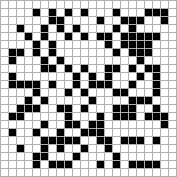
Ed is a methuselah with a lifespan of 30872 generations, discovered by Schneelocke on June 17, 2010, using Nathaniel Johnston's soup search script,[1], at the time the third-largest pattern to be found this way after Fred and Edna.
The pattern is named after Ed Edison from the "Maniac Mansion" computer game, the son of Dr. Fred and his wife Edna.
Formation of Rare patterns
Ed is exceptionally notable because of the formation of a heavyweight spaceship at generation 1833 (which only occurs with a frequency of 1/12,200)[2] and several rare objects, including the boat on boat and the pulsar. The rarest of these is the formation of a trans-barge with tail at generation 6155. The trans-barge with tail occurs with a frequency of 1/6,686,854.[3]
Stable pattern
The stable pattern that results from Ed (excluding 45 escaping gliders and one escaping heavyweight spaceship) oscillates between 2807 and 2833 cells and consists of 218 blocks (including one bi-block), 190 blinkers (including 16 traffic lights), 101 beehives (including two honey farms), 38 loaves, 30 boats, 17 ships, 13 ponds, seven tubs, two toads, two boat-ties, one beacon, one long boat, one ship-tie and one pulsar.
Image gallery
-
 Generation 30872 of Ed (excluding escaping spaceships)

See also
References
- ↑ "Online Life-Like CA Soup Search". Retrieved on June 18, 2010.
- ↑ http://wwwhomes.uni-bielefeld.de/achim/moving.html
- ↑ http://wwwhomes.uni-bielefeld.de/achim/freq_top_life.html