Mango
| Mango | |||||||||
| View static image | |||||||||
| Pattern type | Strict still life | ||||||||
|---|---|---|---|---|---|---|---|---|---|
| Number of cells | 8 | ||||||||
| Bounding box | 5 × 4 | ||||||||
| Frequency class | 10.3 | ||||||||
| Static symmetry | Unspecified | ||||||||
| Discovered by | Unknown | ||||||||
| Year of discovery | 1971 | ||||||||
| |||||||||
| |||||||||
| |||||||||
| |||||||||
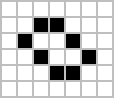
Mango (or cigar or havoc[1]) is an 8-cell still life. It can be seen as a weld of two loaves or of two beehives. It was found in 1971.[2]
Commonness
- Main article: List of common still lifes
Mango is the twelfth most common still life on Adam P. Goucher's Catagolue, being less common than half-bakery but more common than eater 1. Among all still lifes with 8 cells, it is the second most common, being less common than pond but more common than long barge.[3] It is also the sixteenth most common object overall on Catagolue.
In Achim Flammenkamp's census, the mango was also ranked twelfth most common, again between the half-bakery and eater 1.[4]
Glider synthesis
All strict still lifes with a population of 23 or fewer cells, all oscillators with 16 or fewer cells, and all spaceships with 35 or fewer cells are known to be glider-constructible. A glider synthesis of this object can be found in the infobox to the right.
See also
References
- ↑ Adam P. Goucher (July 26, 2019). Re: Help with names (discussion thread) at the ConwayLife.com forums
- ↑ Robert Wainwright (September 1971). Lifeline, vol 3, page 2.
- ↑ Adam P. Goucher. "Statistics". Catagolue. Retrieved on June 24, 2016.
- ↑ Achim Flammenkamp (September 7, 2004). "Most seen natural occurring ash objects in Game of Life". Retrieved on January 15, 2009.
External links
- Mango at the Life Lexicon
- Mango at Adam P. Goucher's Catagolue
- The 9 eight-bit still-lifes at Mark D. Niemiec's Life Page (download pattern file: 0/8cg.rle)
- Mango at Heinrich Koenig's Game of Life Object Catalogs
- Patterns
- Patterns with Catagolue frequency class 10
- Natural periodic objects
- Periodic objects with minimum population 8
- Patterns with 8 cells
- Patterns found in 1971
- Patterns that can be constructed with 3 gliders
- Still lifes
- Strict still lifes
- Strict still lifes with 8 cells
- Patterns with 180-degree rotation symmetry