Block on dock: Difference between revisions
No edit summary |
readded NOTOC |
||
| Line 50: | Line 50: | ||
{{LinkCatagolue|xs14_j1u066z11|patternname=Block on dock}} | {{LinkCatagolue|xs14_j1u066z11|patternname=Block on dock}} | ||
{{LinkNiemiec|p1-14.htm|patternname=The 619 fourteen-bit still-lifes}} | {{LinkNiemiec|p1-14.htm|patternname=The 619 fourteen-bit still-lifes}} | ||
__NOTOC__ | |||
Revision as of 03:55, 4 January 2022
| Block on dock | |||||||||
| View static image | |||||||||
| Pattern type | Strict still life | ||||||||
|---|---|---|---|---|---|---|---|---|---|
| Number of cells | 14 | ||||||||
| Bounding box | 6 × 6 | ||||||||
| Frequency class | 17.5 | ||||||||
| Static symmetry | Unspecified | ||||||||
| Discovered by | Unknown | ||||||||
| Year of discovery | Unknown | ||||||||
| |||||||||
| |||||||||
| |||||||||
| |||||||||
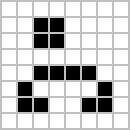
Block on dock is (as its name suggests) a still life made up of a block and dock.
Block on dock is the thirty-fifth most common still life in Achim Flammenkamp's census, being less common than block on table but more common than twin hat.[1] It is also the forty-fifth most common object on Adam P. Goucher's Catagolue.[2]
There are two common ways for block on dock to form. One is for an active region to hit a loaf, causing it to expand but being inducted on one side, which eventually becomes the block. Two example active regions are shown below. On the right of the example is the other common way for it to form; it is a 9-cell predecessor, although sometimes the active region joins the sequence one or two generations later.
|
All strict still lifes with a population of 23 or fewer cells, all oscillators with 16 or fewer cells, and all spaceships with 35 or fewer cells are known to be glider-constructible. A glider synthesis of this object can be found in the infobox to the right.
See also
References
- ↑ Achim Flammenkamp (September 7, 2004). "Most seen natural occurring ash objects in Game of Life". Retrieved on March 30, 2010.
- ↑ Adam P. Goucher. "Statistics". Catagolue. Retrieved on June 24, 2016.
External links
- Block and dock at the Life Lexicon
- The 619 fourteen-bit still-lifes at Mark D. Niemiec's Life Page