Trans-rotated wing: Difference between revisions
Created page with "{{Stilllife |name = Trans-rotated wing |pname = transrotatedwing |c = 16 |bx = 9 |by = 7 |rulemin =..." |
No edit summary |
||
| Line 28: | Line 28: | ||
* [[Cis-mirrored wing]] | * [[Cis-mirrored wing]] | ||
* [[Trans-mirrored wing]] | * [[Trans-mirrored wing]] | ||
* [[Shift- | * [[Shift-mirrored wing]] | ||
* [[Cis-rotated wing]] | * [[Cis-rotated wing]] | ||
* [[Wing bridge wing]] | * [[Wing bridge wing]] | ||
Revision as of 02:49, 27 December 2021
| Trans-rotated wing | |||||||||
| View static image | |||||||||
| Pattern type | Strict still life | ||||||||
|---|---|---|---|---|---|---|---|---|---|
| Number of cells | 16 | ||||||||
| Bounding box | 9 × 7 | ||||||||
| Static symmetry | Unspecified | ||||||||
| Discovered by | Unknown | ||||||||
| Year of discovery | Unknown | ||||||||
| |||||||||
| |||||||||
| |||||||||
| |||||||||
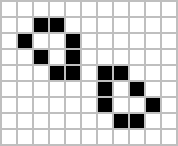
Trans-rotated wing is a 14-cell strict still life consisting of two mutually stabilising wings. It is one of six ways in which two wings can be arranged to create a still life, and one of the five which have two separate islands.
This specific isomer is named trans-rotated due to the two inducting faces being skewed from each other (hence rotated, as skewing forbids mirror symmetry), and the "denser" parts of each island are close to the center (hence trans).
Information on this still life's commonness with respect to other naturally-occurring patterns is currently unknown.
All strict still lifes with a population of 23 or fewer cells, all oscillators with 16 or fewer cells, and all spaceships with 35 or fewer cells are known to be glider-constructible. A glider synthesis of this object can be found in the infobox to the right.
See also
External links
- The 3286 sixteen-bit still-lifes at Mark D. Niemiec's Life Page