Trans-mirrored bun: Difference between revisions
Jump to navigation
Jump to search
No edit summary |
No edit summary |
||
| Line 29: | Line 29: | ||
== See also == | == See also == | ||
* [[Cis-mirrored bun]] | * [[Cis-mirrored bun]] | ||
* [[Shift-mirrored bun]] | |||
* [[Cis-rotated bun]] | * [[Cis-rotated bun]] | ||
* [[Trans-rotated bun]] | * [[Trans-rotated bun]] | ||
* [[Bun bridge bun]] | |||
== References == | == References == | ||
Revision as of 00:12, 25 December 2021
| Trans-mirrored bun | |||||||||
| View static image | |||||||||
| Pattern type | Strict still life | ||||||||
|---|---|---|---|---|---|---|---|---|---|
| Number of cells | 14 | ||||||||
| Bounding box | 7 × 5 | ||||||||
| Frequency class | 19.4 | ||||||||
| Static symmetry | Unspecified | ||||||||
| Discovered by | Unknown | ||||||||
| Year of discovery | Unknown | ||||||||
| |||||||||
| |||||||||
| |||||||||
| |||||||||
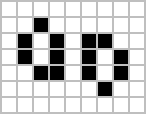
Trans-mirrored bun (or down bun on bun) consists of two buns, reversed and facing each other with one row of dead cells between them so as to stabilize each other. It is one of the five possible ways to combine two buns into a still life.
Trans-mirrored bun is the forty-fourth most common still life in Achim Flammenkamp's census, being less common than long snake but more common than JC.[1] It is also the sixty-first most common object on Adam P. Goucher's Catagolue.[2]
All strict still lifes with a population of 23 or fewer cells, all oscillators with 16 or fewer cells, and all spaceships with 35 or fewer cells are known to be glider-constructible. A glider synthesis of this object can be found in the infobox to the right.
See also
References
- ↑ Achim Flammenkamp (September 7, 2004). "Most seen natural occurring ash objects in Game of Life". Retrieved on January 15, 2009.
- ↑ Adam P. Goucher. "Statistics". Catagolue. Retrieved on June 24, 2016.
External links
- The 619 fourteen-bit still-lifes at Mark D. Niemiec's Life Page