L112: Difference between revisions
LifeViuwur |
discovery ref |
||
| Line 18: | Line 18: | ||
|viewerconfig = #C [[ ZOOM 10 X 0 Y 0 GPS 20 LOOP 113 PAUSE 2 T 112 PAUSE 2 WIDTH 480 HEIGHT 480 THUMBSIZE 2 ]] | |viewerconfig = #C [[ ZOOM 10 X 0 Y 0 GPS 20 LOOP 113 PAUSE 2 T 112 PAUSE 2 WIDTH 480 HEIGHT 480 THUMBSIZE 2 ]] | ||
}} | }} | ||
'''L112''' is a [[composite conduit]], one of the original sixteen [[Herschel conduit]]s, discovered by [[Dave Buckingham]] | '''L112''' is a [[composite conduit]], one of the original sixteen [[Herschel conduit]]s, discovered by [[Dave Buckingham]] on July 5, {{year|1996}}.<ref>{{cite web|url=https://www.conwaylife.com/ref/lifepage/patterns/bhept/bhept.html|title=My Experience with B-heptominos in Oscillators|author=David Buckingham|work=Paul Callahan's Page of Conway's Life Miscellany|date=October 12, 1996|accessdate=November 9, 2020}}</ref> It is made up of two [[elementary conduit]]s, [[HLx53B]] and [[BFx59H]]. After 112 ticks, it produces a [[Herschel]] turned 90 degrees counterclockwise at (12, -33) relative to the input. Its [[recovery time]] is 58 ticks; This is the limit of repeat time for any conduit that contains the [[BFx59H]]. | ||
In the pattern shown in the infobox, a [[ghost Herschel]] marks the output location. | In the pattern shown in the infobox, a [[ghost Herschel]] marks the output location. | ||
| Line 33: | Line 33: | ||
In the [[LifeViewer]] above, the second example's [[Herschel]] collides with the [[block]], but in an actual loop, it is the first example's "next" [[Herschel]] in the loop that will delete this block. | In the [[LifeViewer]] above, the second example's [[Herschel]] collides with the [[block]], but in an actual loop, it is the first example's "next" [[Herschel]] in the loop that will delete this block. | ||
==References== | |||
<references /> | |||
==External links== | ==External links== | ||
{{LinkLexicon|lex_l.htm#l112}} | {{LinkLexicon|lex_l.htm#l112}} | ||
Revision as of 14:43, 9 November 2020
| L112 | |||||||
| View static image | |||||||
| Pattern type | Conduit | ||||||
|---|---|---|---|---|---|---|---|
| Conduit type | Composite | ||||||
| Input | Herschel | ||||||
| Number of cells | 42 | ||||||
| Output orientation | Turned left | ||||||
| Output offset | (-12, -33) | ||||||
| Step | 112 ticks | ||||||
| Recovery time (ignoring FNG if any) |
58 ticks | ||||||
| Minimum overclock period (ignoring FNG if any) |
Unknown | ||||||
| Spartan? | Yes | ||||||
| Dependent? | No | ||||||
| Discovered by | David Buckingham | ||||||
| Year of discovery | 1996 | ||||||
| |||||||
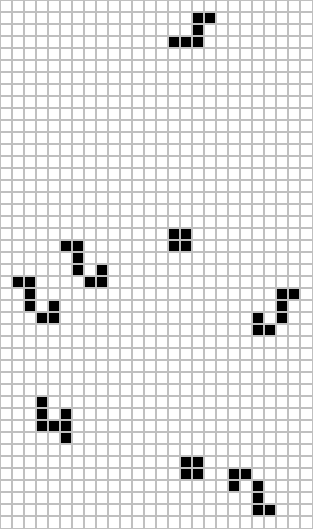
L112 is a composite conduit, one of the original sixteen Herschel conduits, discovered by Dave Buckingham on July 5, 1996.[1] It is made up of two elementary conduits, HLx53B and BFx59H. After 112 ticks, it produces a Herschel turned 90 degrees counterclockwise at (12, -33) relative to the input. Its recovery time is 58 ticks; This is the limit of repeat time for any conduit that contains the BFx59H.
In the pattern shown in the infobox, a ghost Herschel marks the output location.
By removing the eater 1/block constellation on the bottom right, L112 can dependently reflect gliders by 90° and 180° (leaving a block that the next Herschel's spark in the loop can delete), as used in the large quetzal guns. It can also dependently act as a G-to-H when a loaf (or boat), block and snake/eater 1 is added.
| (click above to open LifeViewer) RLE: here Plaintext: here |
- 1. Glider reflects by 180°
- 2. Glider reflects by 90°
- 3. Glider is converted into Herschel with the addition of a loaf, block and eater 1 (RF28B + BFx59H)
In the LifeViewer above, the second example's Herschel collides with the block, but in an actual loop, it is the first example's "next" Herschel in the loop that will delete this block.
References
- ↑ David Buckingham (October 12, 1996). "My Experience with B-heptominos in Oscillators". Paul Callahan's Page of Conway's Life Miscellany. Retrieved on November 9, 2020.
External links
- L112 at the Life Lexicon