Carnival shuttle: Difference between revisions
m templatified links |
CiteHickersonOscillators |
||
| Line 24: | Line 24: | ||
|apgcode = xp12_hv4a4vhzxozw9o9zwccczxozw9o9z06kck6z062326 | |apgcode = xp12_hv4a4vhzxozw9o9zwccczxozw9o9z06kck6z062326 | ||
}} | }} | ||
'''Carnival shuttle''' is a {{period|12}} [[oscillator]] that was found by [[Robert Wainwright]] in September {{year|1984}} (using [[middleweight emulator]]s at the end, instead of the [[monogram|monograms]] shown here). It was used to create the first known non-trivial period {{period|24|brief}} oscillator, [[186P24]]. | '''Carnival shuttle''' is a {{period|12}} [[oscillator]] that was found by [[Robert Wainwright]] in September {{year|1984}} (using [[middleweight emulator]]s at the end, instead of the [[monogram|monograms]] shown here).<ref>{{CiteHickersonOscillators|accessdate=March 14, 2020}}</ref> It was used to create the first known non-trivial period {{period|24|brief}} oscillator, [[186P24]]. | ||
The [[shuttle]] itself is a reaction between two [[t-tetromino]]s. Its stability requires the suppression of one birth per period at both ends of the shuttle. | The [[shuttle]] itself is a reaction between two [[t-tetromino]]s. Its stability requires the suppression of one birth per period at both ends of the shuttle. | ||
| Line 41: | Line 41: | ||
Without sparkers on the ends, a spatial period 12 wick can be constructed. A finite version requires the addition of sparker oscillators as caps. | Without sparkers on the ends, a spatial period 12 wick can be constructed. A finite version requires the addition of sparker oscillators as caps. | ||
==References== | |||
<references /> | |||
==External links== | ==External links== | ||
Revision as of 16:43, 14 March 2020
| Carnival shuttle | |||||||||
| View animated image | |||||||||
| View static image | |||||||||
| Pattern type | Oscillator | ||||||||
|---|---|---|---|---|---|---|---|---|---|
| Oscillator type | Shuttle | ||||||||
| Number of cells | 43 | ||||||||
| Bounding box | 24 × 7 | ||||||||
| Period | 12 (mod: 6) | ||||||||
| Heat | 38 | ||||||||
| Volatility | 0.91 | 0.27 | ||||||||
| Kinetic symmetry | Unspecified | ||||||||
| Discovered by | Robert Wainwright | ||||||||
| Year of discovery | 1984 | ||||||||
| |||||||||
| |||||||||
| |||||||||
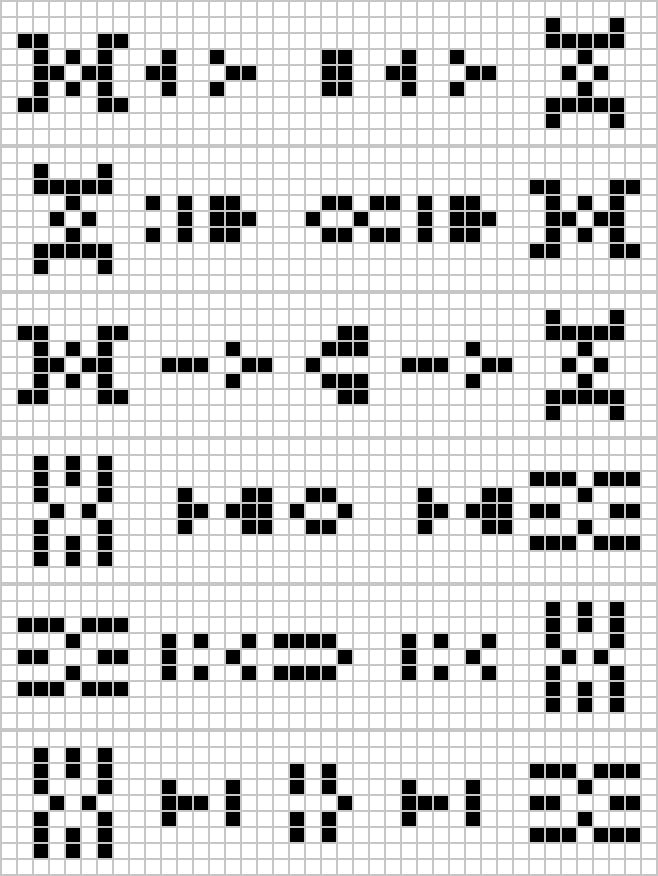
Carnival shuttle is a period-12 oscillator that was found by Robert Wainwright in September 1984 (using middleweight emulators at the end, instead of the monograms shown here).[1] It was used to create the first known non-trivial period 24 oscillator, 186P24.
The shuttle itself is a reaction between two t-tetrominos. Its stability requires the suppression of one birth per period at both ends of the shuttle.
There are many ways to stabilise adjacent shuttles:
| (click above to open LifeViewer) RLE: here Plaintext: here |
Shuttles can also hassle a beehive-traffic light-loaf component. The shuttle can be stabilised by monograms, middleweight emulators and T-nosed p4s. The Blocked p4-3 gives the same spark, and thus can be used as a stabilizer too.
Without sparkers on the ends, a spatial period 12 wick can be constructed. A finite version requires the addition of sparker oscillators as caps.
References
- ↑ Dean Hickerson's oscillator stamp collection. Retrieved on March 14, 2020.
External links
- Carnival shuttle at the Life Lexicon
- Patterns
- Oscillators with 43 cells
- Periodic objects with minimum population 43
- Patterns with 43 cells
- Patterns found by Robert Wainwright
- Patterns found in 1984
- Oscillators
- Shuttles
- Oscillators with period 12
- Oscillators with mod 6
- Oscillators with heat 38
- Oscillators with volatility 0.91
- Oscillators with strict volatility 0.27
- Patterns with bilateral orthogonal symmetry
- Flipping oscillators