BTS: Difference between revisions
Jump to navigation
Jump to search
m isorule |
mNo edit summary |
||
| Line 11: | Line 11: | ||
|isorulemin = B/S2aek3nr | |isorulemin = B/S2aek3nr | ||
|isorulemax = B2in34-ainry5-jqr678/S012345678 | |isorulemax = B2in34-ainry5-jqr678/S012345678 | ||
|plaintext = true | |||
|rle = true | |rle = true | ||
|apgcode = xs19_32qb079czw23 | |apgcode = xs19_32qb079czw23 | ||
Revision as of 22:24, 29 March 2019
| BTS | |||||||||
| View static image | |||||||||
| Pattern type | Strict still life | ||||||||
|---|---|---|---|---|---|---|---|---|---|
| Number of cells | 19 | ||||||||
| Bounding box | 7 × 8 | ||||||||
| Static symmetry | Unspecified | ||||||||
| Discovered by | Mark Niemiec | ||||||||
| Year of discovery | Unknown | ||||||||
| |||||||||
| |||||||||
| |||||||||
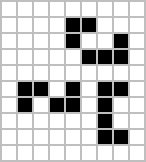
BTS, short for bookend-table-snake, is a 19-cell still life that can be used as a catalyst in a number of ways. Typically, only at least one of two specific cells of the bookend will ever die during a catalysis. The BTS is primarily used in a growing selection of non-Spartan Herschel conduits.
The BTS was first officially enumerated as a still life by Mark Niemiec, but it was not until 2015 that Tanner Jacobi noticed (and somewhat popularized) its usefulness, due to its extensive appearances in results generated by Mike Playle's Bellman program. One example of the surprising number of ways to use this object as a catalyst for signal circuitry can be seen in the CC semi-cenark entry.
External links
- BTS at the Life Lexicon
- BTS at Adam P. Goucher's Catagolue
- Nineteen-Bit Life Objects at Mark D. Niemiec's Life Page