Jam: Difference between revisions
Jump to navigation
Jump to search
m isorule |
m Removed Life 1.05 and 1.06 |
||
| Line 19: | Line 19: | ||
|synthesis = 6 | |synthesis = 6 | ||
|synthesisRLE = true | |synthesisRLE = true | ||
|plaintext = true | |plaintext = true | ||
|rle = true | |rle = true | ||
Revision as of 15:08, 27 January 2019
| Jam | |||||||||
| View animated image | |||||||||
| View static image | |||||||||
| Pattern type | Oscillator | ||||||||
|---|---|---|---|---|---|---|---|---|---|
| Number of cells | 13 | ||||||||
| Bounding box | 7 × 7 | ||||||||
| Frequency class | 27.6 | ||||||||
| Period | 3 (mod: 3) | ||||||||
| Heat | 7.3 | ||||||||
| Volatility | 0.55 | 0.55 | ||||||||
| Kinetic symmetry | Unspecified | ||||||||
| Discovered by | Achim Flammenkamp | ||||||||
| Year of discovery | 1988 | ||||||||
| |||||||||
| |||||||||
| |||||||||
| |||||||||

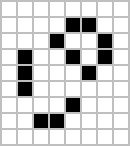
Jam was found by Achim Flammenkamp in 1988, but not widely known about until its independent discovery (and naming) by Dean Hickerson in September 1989. In terms of its 7×7 bounding box it ties with trice tongs as the smallest period 3 oscillator, though caterer has fewer cells.
Jam is about the seventeenth most common naturally-occurring oscillator in Achim Flammenkamp's census, being slightly less common than the blocker.[1] On Catagolue, it is the second most common period 3 oscillator, being less common than the pulsar but more common than the candlefrobra on trans-block.[2]
See also
References
- ↑ Achim Flammenkamp (September 7, 2004). "Most seen natural occurring ash objects in Game of Life". Retrieved on January 15, 2009.
- ↑ Adam P. Goucher. "Census". Catagolue. Retrieved on October 27, 2018.
External links
- Jam at the Life Lexicon
- Jam at Adam P. Goucher's Catagolue
- 13P3.1 at Heinrich Koenig's Game of Life Object Catalogs
Categories:
- Patterns
- Patterns with Catagolue frequency class 27
- Natural periodic objects
- Oscillators with 13 cells
- Periodic objects with minimum population 13
- Patterns with 13 cells
- Patterns found by Achim Flammenkamp
- Patterns found in 1988
- Patterns that can be constructed with 6 gliders
- Oscillators
- Oscillators with period 3
- Oscillators with mod 3
- Oscillators with heat 7
- Oscillators with volatility 0.55
- Oscillators with strict volatility 0.55
- Sparkers
- Weak sparkers
- Sparkers with period 3