Tubber: Difference between revisions
Jump to navigation
Jump to search
symmetry, structure |
No edit summary |
||
| Line 6: | Line 6: | ||
{{LinkLexicon|lex_t.htm#tubber}} | {{LinkLexicon|lex_t.htm#tubber}} | ||
{{Symmetry|diagonal4}} | |||
Revision as of 19:45, 29 March 2016
| Tubber | |||||||
| View animated image | |||||||
| View static image | |||||||
| Pattern type | Oscillator | ||||||
|---|---|---|---|---|---|---|---|
| Number of cells | 48 | ||||||
| Bounding box | 13 × 13 | ||||||
| Period | 3 (mod: Unknown) | ||||||
| Heat | 5.3 | ||||||
| Volatility | 0.14 | 0.14 | ||||||
| Kinetic symmetry | Unspecified | ||||||
| Discovered by | Robert Wainwright | ||||||
| Year of discovery | Unknown | ||||||
| |||||||
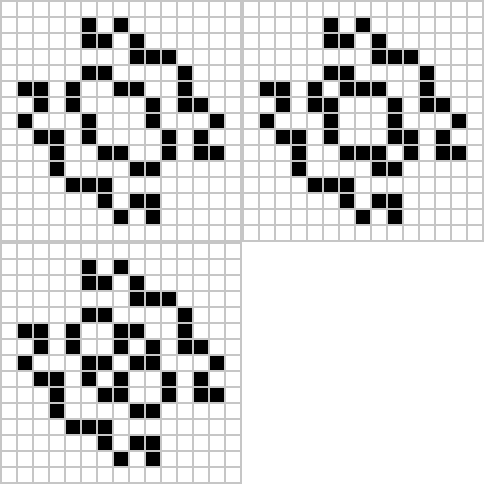
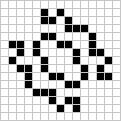
Tubber is a period 3 oscillator that was found by Robert Wainwright no later than June 1972. It is a billiard table configuration requiring particularly heavy stabilization: the smallest casing is twice the size of the bushing.
External links
- Tubber at the Life Lexicon
Categories:
- Patterns
- Oscillators with 48 cells
- Periodic objects with minimum population 48
- Patterns with 48 cells
- Patterns found by Robert Wainwright
- Oscillators
- Oscillators with period 3
- Oscillators with heat 5
- Oscillators with volatility 0.14
- Oscillators with strict volatility 0.14
- Patterns with rectangular diagonal symmetry