Pufferfish: Difference between revisions
Jump to navigation
Jump to search
m corrected reference date and removed extraneous commas |
added synthesis |
||
| Line 1: | Line 1: | ||
{{Puffer|p=12|s=c/2|bx=15|by=12|dir=Orthogonal|name=Pufferfish|pname=pufferfish|c=44|discoverer=Richard Schank|discoveryear=2014|rle=true}} | {{Puffer|p=12|s=c/2|bx=15|by=12|dir=Orthogonal|name=Pufferfish|pname=pufferfish|c=44|discoverer=Richard Schank|discoveryear=2014|rle=true|synthesis=15|synthesisRLE=true}} | ||
'''Pufferfish''' is a [[puffer]] discovered by Richard Schank in [[:Category:Patterns found in 2014|2014]]. Being found in a symmetric [[soup]], the puffer is ''almost'' natural.<ref>{{Cite web|url=http://www.conwaylife.com/forums/viewtopic.php?p=14510#p14510|title=Re: Soup search results|author=Richard Schank|date=November 24, 2014|accessdate=November 25, 2014}}</ref> It consists of a pair of [[b-heptomino]]s whose debris is stabilised by a backend. | '''Pufferfish''' is a [[puffer]] discovered by Richard Schank in [[:Category:Patterns found in 2014|2014]]. Being found in a symmetric [[soup]], the puffer is ''almost'' natural.<ref>{{Cite web|url=http://www.conwaylife.com/forums/viewtopic.php?p=14510#p14510|title=Re: Soup search results|author=Richard Schank|date=November 24, 2014|accessdate=November 25, 2014}}</ref> It consists of a pair of [[b-heptomino]]s whose debris is stabilised by a backend. | ||
Revision as of 21:31, 23 December 2014
| Pufferfish | |||||||
| View static image | |||||||
| Pattern type | Puffer | ||||||
|---|---|---|---|---|---|---|---|
| Number of cells | 44 | ||||||
| Bounding box | 15 × 12 | ||||||
| Direction | Orthogonal | ||||||
| Period | 12 | ||||||
| Speed | c/2 | ||||||
| Discovered by | Richard Schank | ||||||
| Year of discovery | 2014 | ||||||
| |||||||
| |||||||
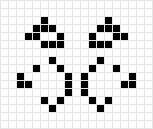
Pufferfish is a puffer discovered by Richard Schank in 2014. Being found in a symmetric soup, the puffer is almost natural.[1] It consists of a pair of b-heptominos whose debris is stabilised by a backend.
It is the first known c/2 object that doesn't have any parts of periods 2 or 4.
References
- ↑ Richard Schank (November 24, 2014). "Re: Soup search results". Retrieved on November 25, 2014.