Trans-mirrored bun: Difference between revisions
No edit summary |
No edit summary |
||
| Line 21: | Line 21: | ||
|viewerconfig = [[ ZOOM 48 ]] | |viewerconfig = [[ ZOOM 48 ]] | ||
}} | }} | ||
'''Trans-mirrored bun''' is a {{slcells|14}}-[[cell]] | '''Trans-mirrored bun''' is a {{slcells|14}}-[[cell]] [[still life#Strict_still_lifes|strict still life]] consisting of two mutually stabilising [[bun]]s. It is one of six ways in which two buns can be arranged to create a still life, and one of the five which have two separate [[island]]s. | ||
This specific [[isomer]] is [[Pattern naming|named]] ''trans-mirrored'' due to the two inducting faces not being skewed from each other (hence ''mirrored''), and the "denser" parts of each island are on opposite sides (hence ''trans''). This naming scheme is technically contradictory due to the lack of mirror symmetry; rather, it is one of the three possible isomers with rotational symmetry. | This specific [[isomer]] is [[Pattern naming|named]] ''trans-mirrored'' due to the two inducting faces not being skewed from each other (hence ''mirrored''), and the "denser" parts of each island are on opposite sides (hence ''trans''). This naming scheme is technically contradictory due to the lack of mirror symmetry; rather, it is one of the three possible isomers with rotational symmetry. | ||
Latest revision as of 08:31, 16 August 2026
| Trans-mirrored bun | |||||||||
| View static image | |||||||||
| Pattern type | Strict still life | ||||||||
|---|---|---|---|---|---|---|---|---|---|
| Number of cells | 14 | ||||||||
| Bounding box | 7 × 5 | ||||||||
| Frequency class | 19.4 | ||||||||
| Static symmetry | .c (C2_1) | ||||||||
| Discovered by | Unknown | ||||||||
| Year of discovery | Unknown | ||||||||
| |||||||||
| |||||||||
| |||||||||
| |||||||||
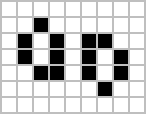
Trans-mirrored bun is a 14-cell strict still life consisting of two mutually stabilising buns. It is one of six ways in which two buns can be arranged to create a still life, and one of the five which have two separate islands.
This specific isomer is named trans-mirrored due to the two inducting faces not being skewed from each other (hence mirrored), and the "denser" parts of each island are on opposite sides (hence trans). This naming scheme is technically contradictory due to the lack of mirror symmetry; rather, it is one of the three possible isomers with rotational symmetry.
Trans-mirrored bun is the forty-fourth most common still life in Achim Flammenkamp's census, being less common than long snake but more common than dead spark coil.[1]
It is the 52nd most common still life on Adam P. Goucher's Catagolue, being less common than cis-shillelagh but more common than trans-block on long bookend. It is the 9th most common still life with 14 cells, being less common than cis-rotated bookend but more common than trans-bookend and bun.[2]
All strict still lifes with a population of 23 or fewer cells, all oscillators with 16 or fewer cells, and all spaceships with 35 or fewer cells are known to be glider-constructible. A glider synthesis of this object can be found in the infobox to the right.
See also
References
- ↑ Achim Flammenkamp (September 7, 2004). "Most seen natural occurring ash objects in Game of Life". Retrieved on January 15, 2009.
- ↑ Adam P. Goucher. "Statistics". Catagolue. Retrieved on May 5, 2023.
External links
- The 619 fourteen-bit still-lifes at Mark D. Niemiec's Life Page