Baker's dozen: Difference between revisions
Name origin |
Carson Cheng (talk | contribs) m the canonical variant is now tied with the cheapest variant |
||
| Line 17: | Line 17: | ||
|isorulemin = B3-ky/S23-cejk | |isorulemin = B3-ky/S23-cejk | ||
|isorulemax = B34ceikqy5-acik6-an7e8/S234cekqtwz5-cinr6ein78 | |isorulemax = B34ceikqy5-acik6-an7e8/S234cekqtwz5-cinr6ein78 | ||
|synthesis | |synthesis = 16 | ||
|synthesisRLE = true | |synthesisRLE = true | ||
|plaintext = true | |plaintext = true | ||
| Line 24: | Line 23: | ||
|animated = true | |animated = true | ||
|apgcode = xp12_2hqz037133zccw6q4wi6zy1oogtozy4bh8 | |apgcode = xp12_2hqz037133zccw6q4wi6zy1oogtozy4bh8 | ||
|pentadecathlonid = 39P12.1 | |pentadecathlonid = 39P12.1 | ||
|viewerconfig = #C [[ GPS 3 ZOOM 16 LOOP 12 ]] | |viewerconfig = #C [[ GPS 3 ZOOM 16 LOOP 12 ]] | ||
Revision as of 11:09, 27 July 2023
| Baker's dozen | |||||||||||
| View animated image | |||||||||||
| View static image | |||||||||||
| Pattern type | Oscillator | ||||||||||
|---|---|---|---|---|---|---|---|---|---|---|---|
| Number of cells | 39 | ||||||||||
| Bounding box | 25 × 11 | ||||||||||
| Period | 12 (mod: 6) | ||||||||||
| Heat | 36.3 | ||||||||||
| Volatility | 0.89 | 0.41 | ||||||||||
| Kinetic symmetry | Unspecified | ||||||||||
| Discovered by | Robert Wainwright | ||||||||||
| Year of discovery | 1989 | ||||||||||
| |||||||||||
| |||||||||||
| |||||||||||
| |||||||||||
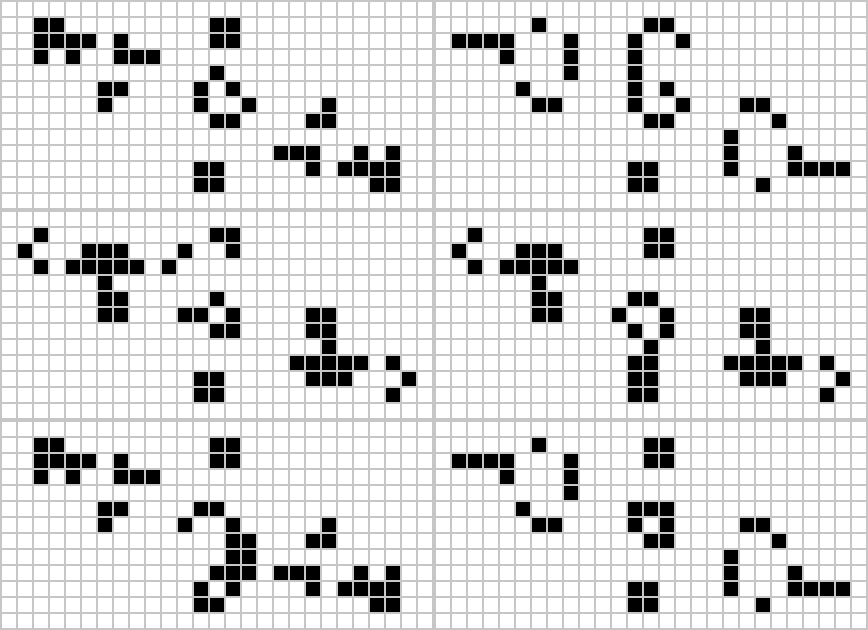

Baker's dozen is a period-12 oscillator consisting of a loaf hassled by two blocks and two caterers. The original form (using period-4 and period-6 oscillators to hassle) was found by Robert Wainwright in August 1989.[1]
It can be stabilised and welded in many ways. A caterer can be used in 2 ways, one way is also suitable for the jam. A mazing would work, and two can be stabilised next to each other. Two opposite ones can be stabilised with two bookends (shown below as bookend on snake). Eater 2s also work,[2] and the eater 2-stabilized version of this oscillator was synthesized with only 24 gliders by iNoMed.[3]
| ||
|
In other rules
Baker's dozen can function without external supports in some isotropic non-totalistic rules suppressing B3q birth, such as B3-q/S23:
| Free baker's dozen in B3-q/S23 (click above to open LifeViewer) Catagolue: here |
See also
- Twirling T-tetsons 2, whose stable form also uses the eater 2-assisted loaf spin reaction
- Popover, using the maze-assisted loaf spin reaction
References
- ↑ Dean Hickerson's oscillator stamp collection. Retrieved on March 14, 2020.
- ↑ Tanner Jacobi (March 11, 2015). Re: Thread For Your Accidental Discoveries (discussion thread) at the ConwayLife.com forums
- ↑ iNoMed (April 19, 2021). Message in #cgol on the Conwaylife Lounge Discord server
External links
- Baker's dozen at the Life Lexicon
- Baker's dozen at Adam P. Goucher's Catagolue
- Baker's dozen w/ eater 2s at Adam P. Goucher's Catagolue
- Baker's dozen w/ short keys at Adam P. Goucher's Catagolue
- 39P12.1 at Heinrich Koenig's Game of Life Object Catalogs
- Baker's dozen at Wikipedia (name origin, meaning a count of 13 which is one more than the period of this oscillator)
- Patterns
- Oscillators with 39 cells
- Periodic objects with minimum population 39
- Patterns with 39 cells
- Patterns found by Robert Wainwright
- Patterns found in 1989
- Patterns that can be constructed with 16 gliders
- Oscillators
- Oscillators with period 12
- Oscillators with mod 6
- Oscillators with heat 36
- Oscillators with volatility 0.89
- Oscillators with strict volatility 0.41
- Non-flipping oscillators that turn 180 degrees