Hat: Difference between revisions
→Uses: restore formatting that was reverted without explanation; see Talk:Hat#Links and markup |
→As a rock: rq cleanup per talk page (multiple inline external links which should probably be converted to footnotes) |
||
| Line 27: | Line 27: | ||
== Uses == | == Uses == | ||
=== As a rock === | === As a rock === | ||
{{cleanup}} | |||
It (as well as similar still lifes such as [[mirrored table]]) can be used as an [[eater]] (in particular, a [[rock]]) stabilising {{LinkCatagolue|xp46_x8e1e8zzzckgsxsgkczzx17871|patternname=a stator variant|style=raw}} of the [[twin bees shuttle]]. The mechanism has some similarities to [[snake]]-type eaters. | It (as well as similar still lifes such as [[mirrored table]]) can be used as an [[eater]] (in particular, a [[rock]]) stabilising {{LinkCatagolue|xp46_x8e1e8zzzckgsxsgkczzx17871|patternname=a stator variant|style=raw}} of the [[twin bees shuttle]]. The mechanism has some similarities to [[snake]]-type eaters. | ||
Revision as of 18:53, 8 May 2023
| Hat | |||||||||
| View static image | |||||||||
| Pattern type | Strict still life | ||||||||
|---|---|---|---|---|---|---|---|---|---|
| Number of cells | 9 | ||||||||
| Bounding box | 5 × 4 | ||||||||
| Frequency class | 15.3 | ||||||||
| Static symmetry | Unspecified | ||||||||
| Discovered by | Unknown | ||||||||
| Year of discovery | 1971 | ||||||||
| |||||||||
| |||||||||
| |||||||||
| |||||||||
- For other uses of 'Hat', see Hat (disambiguation).
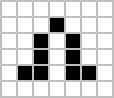
Hat is a 9-cell still life that was discovered independently in 1971 by several Life enthusiasts and named by Charles Corderman.[1][2]
The loop and eleven loop can be seen as the long and long long versions of the hat. Orthogonally lengthened versions of the hat are also possible still life components (a longlong3 version appears in Cthulhu), though they are not still lifes of their own.
Uses
As a rock

|
This article may require cleanup to meet LifeWiki's quality standards. |
It (as well as similar still lifes such as mirrored table) can be used as an eater (in particular, a rock) stabilising a stator variant of the twin bees shuttle. The mechanism has some similarities to snake-type eaters.
It also functions at the same orientation as the rock of a period-4 oscillator with two mirrored 20P4 halves, one on either side of it. The unnamed region may also instead be supported by eaters or mutually support ponds hassled at period-4, forming a D8_1-symmetrical tetramerisation.
Commonness
- Main article: List of common still lifes
Hat is the twenty-fifth most common still life in Achim Flammenkamp's census, being less common than trans-boat with tail but more common than boat tie ship.[3]
It is the 26th most common still life on Adam P. Goucher's Catagolue, being less common than boat tie ship but more common than very long ship. It is the 3rd most common still life with 9 cells, being less common than trans-boat with tail but more common than very long boat.[4]
Glider synthesis
All strict still lifes with a population of 23 or fewer cells, all oscillators with 16 or fewer cells, and all spaceships with 35 or fewer cells are known to be glider-constructible. A glider synthesis of this object can be found in the infobox to the right.
See also
References
- ↑ Dean Hickerson's oscillator stamp collection. Retrieved on March 14, 2020.
- ↑ Robert Wainwright (June 1971). Lifeline, vol 2, page 3.
- ↑ Achim Flammenkamp (September 7, 2004). "Most seen natural occurring ash objects in Game of Life". Retrieved on January 15, 2009.
- ↑ Adam P. Goucher. "Statistics". Catagolue. Retrieved on May 5, 2023.
External links
- Hat at the Life Lexicon
- Hat at Adam P. Goucher's Catagolue
- The 10 nine-bit still-lifes at Mark D. Niemiec's Life Page (download pattern file: 0/9-10.rle)
- Hat at Heinrich Koenig's Game of Life Object Catalogs
- Patterns
- Patterns with Catagolue frequency class 15
- Natural periodic objects
- Periodic objects with minimum population 9
- Patterns with 9 cells
- Patterns found in 1971
- Patterns that can be constructed with 3 gliders
- Still lifes
- Strict still lifes
- Strict still lifes with 9 cells
- Patterns with bilateral orthogonal symmetry
- Catalysts
- Eaters