42P38: Difference between revisions
→LCM oscillators: test STARTFROM suggested in a discussion https://conwaylife.com/w/index.php?curid=28058&diff=129704&oldid=129703 |
No edit summary |
||
| Line 17: | Line 17: | ||
|isorulemin = B3/S23 | |isorulemin = B3/S23 | ||
|isorulemax = B34e5ce6n7c8/S234cey5e6i7e8 | |isorulemax = B34e5ce6n7c8/S234cey5e6i7e8 | ||
|synthesis = 22 | |||
|rle = true | |rle = true | ||
|apgcode = xp38_y2178czy8s4cy1szsoyfesz01sy1ogszy9o8gzyb32 | |apgcode = xp38_y2178czy8s4cy1szsoyfesz01sy1ogszy9o8gzyb32 | ||
| Line 23: | Line 24: | ||
'''42P38''' is a small {{period|38}} [[oscillator]] found by [[Mitchell Riley]] on April 21, {{year|2023}}. With only 42 cells, it is the smallest known period-38 oscillator by population; surpassing [[44P38]]. It consists of an [[R-pentomino]] turning into an [[octomino II]] via [[fishhook]], then turning back into an R-pentomino via a combination of a [[transparent]] [[blinker]] plus [[toad]] catalyst and hitting a second copy of itself. | '''42P38''' is a small {{period|38}} [[oscillator]] found by [[Mitchell Riley]] on April 21, {{year|2023}}. With only 42 cells, it is the smallest known period-38 oscillator by population; surpassing [[44P38]]. It consists of an [[R-pentomino]] turning into an [[octomino II]] via [[fishhook]], then turning back into an R-pentomino via a combination of a [[transparent]] [[blinker]] plus [[toad]] catalyst and hitting a second copy of itself. | ||
It is a delayed domino sparker, allowing for the construction of | It is a delayed domino sparker, allowing for the construction of a [[Honey farm hasslers#p38|p38 honey farm hassler]] and some [[LCM oscillator]]s. | ||
[[Carson Cheng]] found a {{gliders|22}} synthesis of this oscillator on April 26th, 2023.<ref name="message1100579873845690388" /> | |||
== LCM oscillators == | == LCM oscillators == | ||
| Line 64: | Line 67: | ||
==References== | ==References== | ||
<references> | <references> | ||
<ref name="message1100579873845690388">{{CiteDiscord | |||
|author = carsoncheng | |||
|date = April 26, 2023 | |||
|channel = cgol | |||
|id = 1100579873845690388 | |||
}}</ref> | |||
</references> | </references> | ||
Revision as of 00:43, 26 April 2023
| 42P38 | |||||||||
| View static image | |||||||||
| Pattern type | Oscillator | ||||||||
|---|---|---|---|---|---|---|---|---|---|
| Number of cells | 42 | ||||||||
| Bounding box | 25 × 27 | ||||||||
| Period | 38 (mod: 38) | ||||||||
| Heat | 45.5 | ||||||||
| Volatility | 0.93 | 0.87 | ||||||||
| Kinetic symmetry | Unspecified | ||||||||
| Discovered by | Mitchell Riley | ||||||||
| Year of discovery | 2023 | ||||||||
| |||||||||
| |||||||||
| |||||||||
| |||||||||
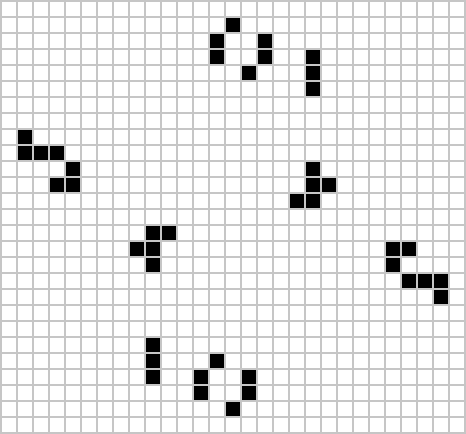
42P38 is a small period-38 oscillator found by Mitchell Riley on April 21, 2023. With only 42 cells, it is the smallest known period-38 oscillator by population; surpassing 44P38. It consists of an R-pentomino turning into an octomino II via fishhook, then turning back into an R-pentomino via a combination of a transparent blinker plus toad catalyst and hitting a second copy of itself.
It is a delayed domino sparker, allowing for the construction of a p38 honey farm hassler and some LCM oscillators.
Carson Cheng found a 22-glider synthesis of this oscillator on April 26th, 2023.[1]
LCM oscillators
The LCM oscillators below are listed due to being the smallest known ones by population, while also satisfying the condition that at least one cell oscillates at the full period.
| ||
| ||
| ||
|
References
- ↑ carsoncheng (April 26, 2023). Message in #cgol on the Conwaylife Lounge Discord server
External links
- Patterns
- Oscillators with 42 cells
- Periodic objects with minimum population 42
- Patterns with 42 cells
- Patterns found by Mitchell Riley
- Patterns found in 2023
- Patterns that can be constructed with 22 gliders
- Oscillators
- Oscillators with period 38
- Oscillators with mod 38
- Oscillators with heat 45
- Oscillators with volatility 0.93
- Oscillators with strict volatility 0.87
- R-pentomino hasslers
- Sparkers
- Sparkers with period 38
- Domino sparkers
- Strong sparkers