Krake: Difference between revisions
Jump to navigation
Jump to search
use as double Eater 1 |
name note |
||
| Line 17: | Line 17: | ||
|pentadecathlonid = 13.44 | |pentadecathlonid = 13.44 | ||
}} | }} | ||
'''Krake''' is a {{slcells|13}}-[[cell]] [[still life]]. | '''Krake'''{{refn|group="notes"|The origin of the name is not known. However, krake means octopus in German and the name seems to have first appeared in [[Achim Flammenkamp's census]] in 2004.}} is a {{slcells|13}}-[[cell]] [[still life]]. | ||
== Uses == | == Uses == | ||
| Line 30: | Line 30: | ||
== See also == | == See also == | ||
* [[Test tube baby]], two eater 1s placed farther apart by one cell, making it a period-2 oscillator | * [[Test tube baby]], two eater 1s placed farther apart by one cell, making it a period-2 oscillator | ||
* [[Hungry hat]] | * [[Hungry hat]] | ||
* [[Aries]] | * [[Aries]] | ||
==Notes== | |||
<references group=notes /> | |||
== External links == | == External links == | ||
Revision as of 19:58, 24 June 2022
| Krake | |||||||||
| View static image | |||||||||
| Pattern type | Strict still life | ||||||||
|---|---|---|---|---|---|---|---|---|---|
| Number of cells | 13 | ||||||||
| Bounding box | 7 × 5 | ||||||||
| Frequency class | 23.4 | ||||||||
| Static symmetry | Unspecified | ||||||||
| Discovered by | Unknown | ||||||||
| Year of discovery | Unknown | ||||||||
| |||||||||
| |||||||||
| |||||||||
| |||||||||
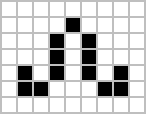
Krake[notes 1] is a 13-cell still life.
Uses
The krake is sometimes used when two eater 1s need to be placed close together.
It is the 143rd most common still life on Adam P. Goucher's Catagolue.
All strict still lifes with a population of 23 or fewer cells, all oscillators with 16 or fewer cells, and all spaceships with 35 or fewer cells are known to be glider-constructible. A glider synthesis of this object can be found in the infobox to the right.
See also
- Test tube baby, two eater 1s placed farther apart by one cell, making it a period-2 oscillator
- Hungry hat
- Aries
Notes
- ↑ The origin of the name is not known. However, krake means octopus in German and the name seems to have first appeared in Achim Flammenkamp's census in 2004.
External links
- 13.44 at Heinrich Koenig's Game of Life Object Catalogs
- The 240 thirteen-bit still-lifes at Mark D. Niemiec's Life Page