Trans-rotated wing: Difference between revisions
pdid |
→External links: added NOTOC using AutoWikiBrowser |
||
| Line 41: | Line 41: | ||
{{Symmetry|180degree}} | {{Symmetry|180degree}} | ||
__NOTOC__ | |||
Revision as of 22:33, 4 January 2022
| Trans-rotated wing | |||||||||
| View static image | |||||||||
| Pattern type | Strict still life | ||||||||
|---|---|---|---|---|---|---|---|---|---|
| Number of cells | 16 | ||||||||
| Bounding box | 9 × 7 | ||||||||
| Frequency class | 29.9 | ||||||||
| Static symmetry | Unspecified | ||||||||
| Discovered by | Unknown | ||||||||
| Year of discovery | Unknown | ||||||||
| |||||||||
| |||||||||
| |||||||||
| |||||||||

|
This page may meet the criteria for deletion because of the following concern:
Please share your thoughts on this matter on this article's talk page. If you can address the above concern by improving the article, please edit this page and do so, but do not remove this notice unless at least fourteen days have passed since this tag was added and a consensus has been reached that the page should not be deleted. Moderators: check links, history and logs before deletion. Consider checking Google. |
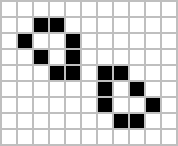
Trans-rotated wing is a 16-cell strict still life consisting of two mutually stabilising wings. It is one of six ways in which two wings can be arranged to create a still life, and one of the five which have two separate islands.
This specific isomer is named trans-rotated due to the two inducting faces being skewed from each other (hence rotated, as skewing forbids mirror symmetry), and the "denser" parts of each island are close to the center (hence trans).
Information on this still life's commonness with respect to other naturally-occurring patterns is currently unknown.
All strict still lifes with a population of 23 or fewer cells, all oscillators with 16 or fewer cells, and all spaceships with 35 or fewer cells are known to be glider-constructible. A glider synthesis of this object can be found in the infobox to the right.
See also
External links
- 16.2703 at Heinrich Koenig's Game of Life Object Catalogs
- The 3286 sixteen-bit still-lifes at Mark D. Niemiec's Life Page