Long integral: Difference between revisions
Jump to navigation
Jump to search
No edit summary |
10-cell still lifes: December 1972 via Lifeline Volume 8, page 2 |
||
| Line 6: | Line 6: | ||
|by = 6 | |by = 6 | ||
|fc = 20.5 | |fc = 20.5 | ||
|discoveryear = 1972 | |||
|rulemin = B/S23 | |rulemin = B/S23 | ||
|rulemax = B3678/S012345678 | |rulemax = B3678/S012345678 | ||
Revision as of 17:25, 30 May 2022
| Long integral | |||||||||
| View static image | |||||||||
| Pattern type | Strict still life | ||||||||
|---|---|---|---|---|---|---|---|---|---|
| Number of cells | 10 | ||||||||
| Bounding box | 4 × 6 | ||||||||
| Frequency class | 20.5 | ||||||||
| Static symmetry | Unspecified | ||||||||
| Discovered by | Unknown | ||||||||
| Year of discovery | 1972 | ||||||||
| |||||||||
| |||||||||
| |||||||||
| |||||||||
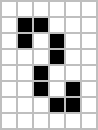
Long integral (or S-ten) is a 10-cell still life; it is the long version of the integral sign. Unlike it, it cannot act as a glider eater.
Long integral is the seventieth most common still life in Achim Flammenkamp's census, being less common than hook with tail but more common than eleven loop.[1] It is also the seventy-seventh most common object on Adam P. Goucher's Catagolue.[2]
All strict still lifes with a population of 23 or fewer cells, all oscillators with 16 or fewer cells, and all spaceships with 35 or fewer cells are known to be glider-constructible. A glider synthesis of this object can be found in the infobox to the right.
See also
References
- ↑ Achim Flammenkamp (September 7, 2004). "Most seen natural occurring ash objects in Game of Life". Retrieved on November 8, 2009.
- ↑ Adam P. Goucher. "Statistics". Catagolue. Retrieved on June 24, 2016.
External links
- Long integral at the Life Lexicon
- The 25 ten-bit still-lifes at Mark D. Niemiec's Life Page
Categories:
- Patterns
- Patterns with Catagolue frequency class 20
- Natural periodic objects
- Periodic objects with minimum population 10
- Patterns with 10 cells
- Patterns found in 1972
- Patterns that can be constructed with 4 gliders
- Still lifes
- Strict still lifes
- Strict still lifes with 10 cells
- Patterns with 180-degree rotation symmetry