Caterloopillar: Difference between revisions
mention David Bell |
mention Jason Summers |
||
| Line 9: | Line 9: | ||
'''Caterloopillar''' is the name given to a family of [[spaceship]]s containing two major parts - the front and the back. In Caterloopillar each part has the properties of [[universal construction]], and thus each part is constructing the building blocks of the other part, while also reading and moving a construction tape. As the name suggests, this creates somewhat paradoxical design, similar to the [https://en.wikipedia.org/wiki/Strange_loop Strange loop] concept. | '''Caterloopillar''' is the name given to a family of [[spaceship]]s containing two major parts - the front and the back. In Caterloopillar each part has the properties of [[universal construction]], and thus each part is constructing the building blocks of the other part, while also reading and moving a construction tape. As the name suggests, this creates somewhat paradoxical design, similar to the [https://en.wikipedia.org/wiki/Strange_loop Strange loop] concept. | ||
The general design | The general design was proposed by David Bell in October [[:Category:Patterns found in 2006|2006]] in [[LifeCA]] mailing list<ref>{{cite web|url=http://www.conwaylife.com/forums/viewtopic.php?p=13217#p13217|title=Idea for various speed Caterpillars based on standard spaceships|author=David Bell|date=October 8, 2006|accessdate=April 11, 2016}}</ref> and allegedly earlier and independently by Jason Summers. The first Caterloopillar was constructed by [[:Category:Patterns found by Michael Simkin|Michael Simkin]] and completed on April 9, [[:Category:Patterns found in 2016|2016]]. This Caterloopillar has a speed of [[c/8 orthogonal|c/8]]. | ||
Caterloopillars with many other speeds can be constructed using a slightly modified design. The major limitation of this design is upper bound of speed c/4, as the signal transferring is done by converting a [[still life]] into a [[glider]] and back, thus limiting the moving speed of the tape to c/4 (the speed of the glider). | Caterloopillars with many other speeds can be constructed using a slightly modified design. The major limitation of this design is upper bound of speed c/4, as the signal transferring is done by converting a [[still life]] into a [[glider]] and back, thus limiting the moving speed of the tape to c/4 (the speed of the glider). | ||
Revision as of 18:47, 11 April 2016
| Caterloopillar | |||||||
| |||||||
| View static image | |||||||
| Pattern type | Spaceship | ||||||
|---|---|---|---|---|---|---|---|
| Number of cells | 232815 | ||||||
| Bounding box | 734 × 514927 | ||||||
| Direction | Orthogonal | ||||||
| Period | 2000 (mod: Unknown) | ||||||
| Speed | c/8 | Unknown | ||||||
| Heat | Unknown | ||||||
| Kinetic symmetry | Unspecified | ||||||
| Discovered by | Michael Simkin | ||||||
| Year of discovery | 2016 | ||||||
| |||||||

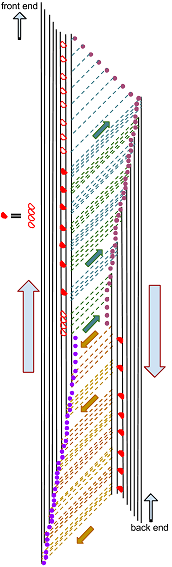
Caterloopillar is the name given to a family of spaceships containing two major parts - the front and the back. In Caterloopillar each part has the properties of universal construction, and thus each part is constructing the building blocks of the other part, while also reading and moving a construction tape. As the name suggests, this creates somewhat paradoxical design, similar to the Strange loop concept.
The general design was proposed by David Bell in October 2006 in LifeCA mailing list[1] and allegedly earlier and independently by Jason Summers. The first Caterloopillar was constructed by Michael Simkin and completed on April 9, 2016. This Caterloopillar has a speed of c/8.
Caterloopillars with many other speeds can be constructed using a slightly modified design. The major limitation of this design is upper bound of speed c/4, as the signal transferring is done by converting a still life into a glider and back, thus limiting the moving speed of the tape to c/4 (the speed of the glider).
See also
References
- ↑ David Bell (October 8, 2006). "Idea for various speed Caterpillars based on standard spaceships". Retrieved on April 11, 2016.
External links
- Michael Simkin (April 9, 2016). "Caterloopillar WIP (all speeds < c/4)".
- Hartmut Holzwart (September 11, 2014). "David Bell's engineless caterpillar idea revisited".
- Caterloopillar GitHub repository
- Caterloopillar c/8 RLE file
- Patterns
- Spaceships with between 100,000 and 999,999 cells
- Periodic objects with minimum population between 100,000 and 999,999
- Patterns with between 100,000 and 999,999 cells
- Patterns found by Michael Simkin
- Patterns found in 2016
- Outer-totalistically endemic patterns
- Spaceships
- Spaceships with period 2000
- Orthogonal spaceships
- Spaceships with speed c/8
- Non-monotonic spaceships