Dinner table: Difference between revisions
Jump to navigation
Jump to search
No edit summary |
Apple Bottom (talk | contribs) LinkCatagolue |
||
| Line 19: | Line 19: | ||
{{LinkWeisstein|DinnerTable.html}} | {{LinkWeisstein|DinnerTable.html}} | ||
{{LinkLexicon|lex_d.htm#dinnertable}} | {{LinkLexicon|lex_d.htm#dinnertable}} | ||
{{LinkCatagolue|xp12_032acy0oge2z0g8ow77ggz23y21226}} | |||
{{Symmetry|osc=turn90}} | {{Symmetry|osc=turn90}} | ||
Revision as of 10:30, 20 April 2016
| Dinner table | |||||||
| View animated image | |||||||
| View static image | |||||||
| Pattern type | Oscillator | ||||||
|---|---|---|---|---|---|---|---|
| Number of cells | 33 | ||||||
| Bounding box | 13 × 13 | ||||||
| Period | 12 (mod: Unknown) | ||||||
| Heat | 10.0 | ||||||
| Volatility | 0.55 | Unknown | ||||||
| Kinetic symmetry | Unspecified | ||||||
| Discovered by | Robert Wainwright | ||||||
| Year of discovery | 1972 | ||||||
| |||||||
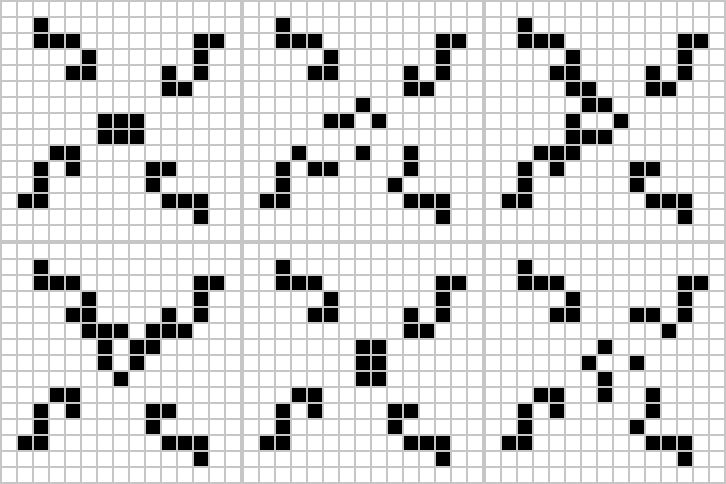
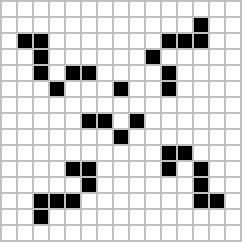
Dinner table is a period 12 oscillator. It was the first period 12 oscillator to be found, and was discovered by Robert Wainwright in 1972.[1] It consists of four eater 1s hassling a pre-beehive. In terms of its minimum population of 33 cells, it is the smallest known non-trivial period 12 oscillator, although the trivial mold and long hook eating tub contains only 24 cells.[2] It can also be extended as an agar.
Image gallery
 |
 RLE: here |
See also
References
- ↑ Dean Hickerson's oscillator stamp collection.
- ↑ "Class 2 Objects Catalog". Retrieved on April 9, 2009.
External links
- Dinner table at the Life Lexicon