Hooked tail: Difference between revisions
Jump to navigation
Jump to search
No edit summary |
No edit summary |
||
| Line 8: | Line 8: | ||
|plaintext = true | |plaintext = true | ||
|rle = true | |rle = true | ||
|viewerconfig = [[ ZOOM 60 ]] | |||
}} | }} | ||
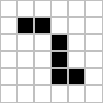
'''Hooked tail''' (or '''bend tail''') is a {{cells|6|text=6-cell}} [[still life component]], and an extension of [[tail]] by two cells (a [[domino]]). | '''Hooked tail''' (or '''bend tail''') is a {{cells|6|text=6-cell}} [[still life component]], and an extension of [[tail]] by two cells (a [[domino]]). | ||
Latest revision as of 21:48, 13 November 2024
| Hooked tail | |||||||
| View static image | |||||||
| Pattern type | Still life component | ||||||
|---|---|---|---|---|---|---|---|
| Number of cells | 6 | ||||||
| Bounding box | 4 × 4 | ||||||
| Static symmetry | C1 | ||||||
| Discovered by | Unknown | ||||||
| Year of discovery | Unknown | ||||||
| |||||||
Hooked tail (or bend tail) is a 6-cell still life component, and an extension of tail by two cells (a domino).
Not all objects which can have tails attached can have hooked tails attached (and for those that do, isomeric variants may not exist), as hooked tails attach in a fundamentally different way to normal tails. The following are examples of small objects with hooked tails:
-

-

-

-
 snorkel loop (claw with hooked tail)
-
 crinkly heptomino with hooked tail
-