Fox: Difference between revisions
Jump to navigation
Jump to search
Haycat2009 (talk | contribs) m Undo revision 145950 by Haycat2009 (talk) Tag: Undo |
Haycat2009 (talk | contribs) |
||
| Line 44: | Line 44: | ||
==See also== | ==See also== | ||
* [[Caterer]] | * [[Caterer]] | ||
* [[Lei]] | |||
==References== | ==References== | ||
Revision as of 09:44, 9 July 2024
| Fox | |||||||||
| View animated image | |||||||||
| View static image | |||||||||
| Pattern type | Oscillator | ||||||||
|---|---|---|---|---|---|---|---|---|---|
| Number of cells | 12 | ||||||||
| Bounding box | 8 × 7 | ||||||||
| Frequency class | 35.6 | ||||||||
| Period | 2 (mod: 2) | ||||||||
| Heat | 18 | ||||||||
| Volatility | 0.86 | 0.86 | ||||||||
| Kinetic symmetry | Unspecified | ||||||||
| Discovered by | David Buckingham | ||||||||
| Year of discovery | 1977 | ||||||||
| |||||||||
| |||||||||
| |||||||||
| |||||||||
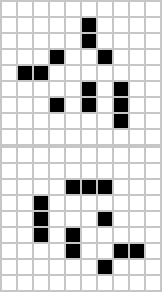
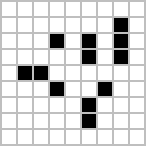
Fox (or gnome[1]) is the smallest period-2 oscillator with an asymmetric rotor. It was found by David Buckingham in July 1977.[2]
It is the 74th most common oscillator on Adam P. Goucher's Catagolue.
Fox+Clock catalyst
A fox can be paired with a clock to make a periodic catalyst:
| (click above to open LifeViewer) RLE: here Plaintext: here |
All strict still lifes with a population of 23 or fewer cells, all oscillators with 16 or fewer cells, and all spaceships with 35 or fewer cells are known to be glider-constructible. A glider synthesis of this object can be found in the infobox to the right.
See also
References
- ↑ "Gnome". The Life Lexicon. Stephen Silver. Retrieved on June 21, 2011.
- ↑ Dean Hickerson's oscillator stamp collection. Retrieved on June 21, 2011.
External links
- Fox at the Life Lexicon
- Fox at Adam P. Goucher's Catagolue
- 12P2.1 at Heinrich Koenig's Game of Life Object Catalogs
Categories:
- Patterns
- Patterns with Catagolue frequency class 35
- Natural periodic objects
- Oscillators with 12 cells
- Periodic objects with minimum population 12
- Patterns with 12 cells
- Patterns found by David Buckingham
- Patterns found in 1977
- Patterns that can be constructed with 6 gliders
- Oscillators
- Oscillators with period 2
- Oscillators with mod 2
- Oscillators with heat 18
- Oscillators with volatility 0.86
- Oscillators with strict volatility 0.86