P67 Herschel loop: Difference between revisions
Haycat2009 (talk | contribs) mNo edit summary |
Haycat2009 (talk | contribs) mNo edit summary |
||
| Line 41: | Line 41: | ||
|viewerconfig = #C [[ AUTOSTART HEIGHT 600 WIDTH 600 ZOOM 8 GPS 20 ]] | |viewerconfig = #C [[ AUTOSTART HEIGHT 600 WIDTH 600 ZOOM 8 GPS 20 ]] | ||
|position = center | |position = center | ||
|caption = The current smallest known p67 Herschel loop, using a pair of [[R49]]s and [[R152]]s with 6 evenly-spaced Herschels, with a [[population]] of 286 cells and a [[bounding box]] of 4118. | |caption = The current smallest known p67 Herschel loop, using a pair of [[R49]]s and [[R152]]s with 6 evenly-spaced Herschels, with a [[population]] of 286 cells and a [[bounding box]] of {{eq|{{times|71|58}}|4118}}. | ||
|style = width:300px; | |style = width:300px; | ||
|apgcode = xp67_x8k80u156ggg0s2mkk8y7bdy3ggzy311w1101101y7ggy3g01210ggzwc84cy1ac8yb11y1279sxmbdoozyzy03231y2ca23zyho8yfcia4y666zyf321ybc453y9c4oz02egoy0g4scyuc4ogy111zy3269cyuce83y062sgz178cy9g88cycggzooy68kic011yc4701z0ggkcy3gggz01y467dkrxe4ogyi4cky1c84czy833wgw31y233zyb321y2cky74aargf1233o81v04a4zyk11yi11 | |apgcode = xp67_x8k80u156ggg0s2mkk8y7bdy3ggzy311w1101101y7ggy3g01210ggzwc84cy1ac8yb11y1279sxmbdoozyzy03231y2ca23zyho8yfcia4y666zyf321ybc453y9c4oz02egoy0g4scyuc4ogy111zy3269cyuce83y062sgz178cy9g88cycggzooy68kic011yc4701z0ggkcy3gggz01y467dkrxe4ogyi4cky1c84czy833wgw31y233zyb321y2cky74aargf1233o81v04a4zyk11yi11 | ||
Revision as of 07:09, 12 November 2023
| p67 Herschel loop | |||||||||
| View static image | |||||||||
| Pattern type | Oscillator | ||||||||
|---|---|---|---|---|---|---|---|---|---|
| Number of cells | 294 | ||||||||
| Bounding box | 72 × 69 | ||||||||
| Period | 67 (mod: 67) | ||||||||
| Heat | 147.3 | ||||||||
| Volatility | 0.91 | 0.91 | ||||||||
| Kinetic symmetry | Unspecified | ||||||||
| Discovered by | David Buckingham | ||||||||
| Year of discovery | 1996 | ||||||||
| |||||||||
| |||||||||
| |||||||||
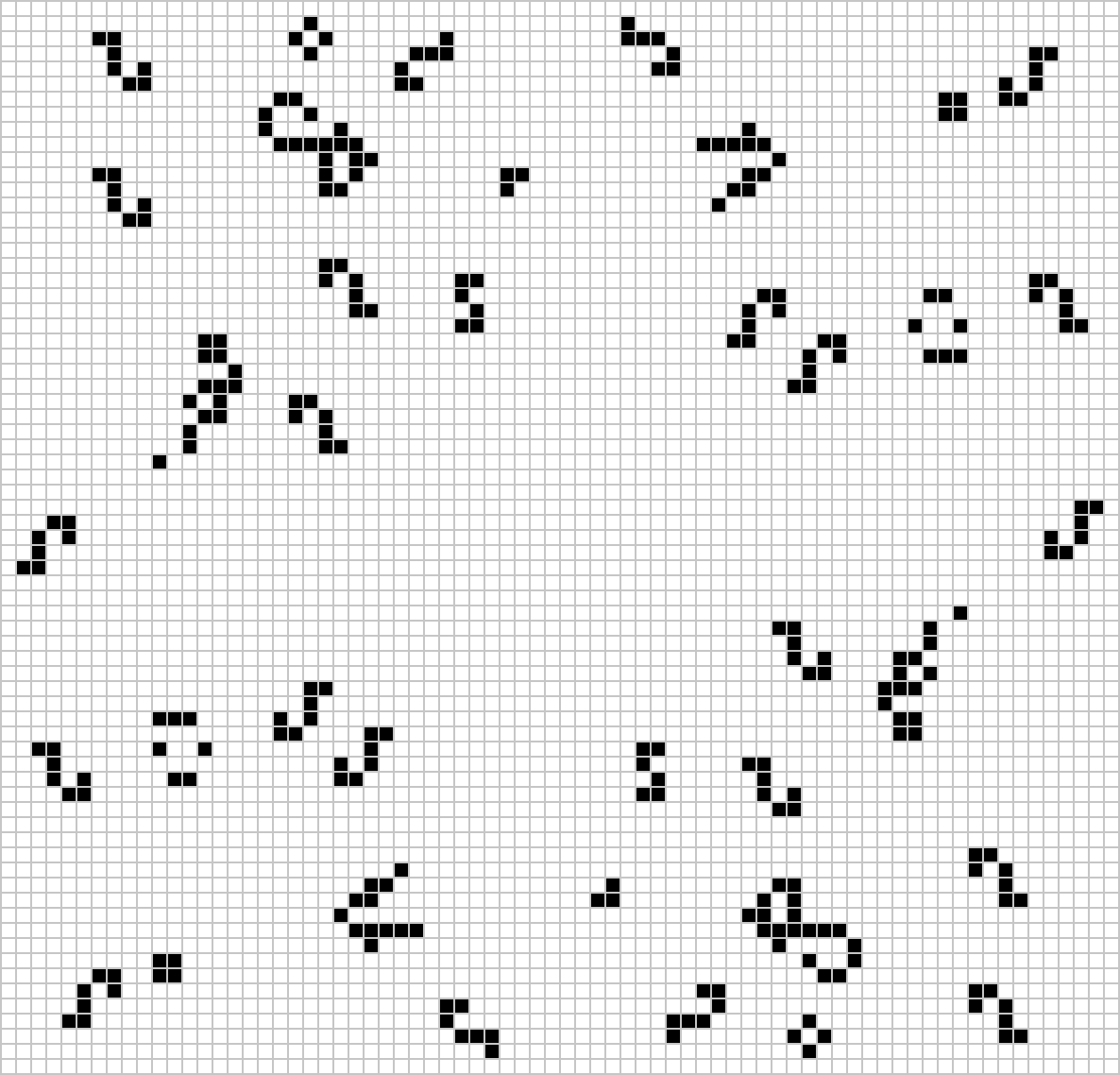
The p67 Herschel loop is the first known period-67 glider gun, discovered by David Buckingham in August 1996.[1][2] The loop is based on stable Herschel track technology. The loop consists of two instances of L112 and two instances of glider-releasing L156, with eight evenly-spaced circulating signals. The infobox shows the oscillator version; it can be turned into a glider gun by removing eater 1s blocking the glider outputs of the L156.
Along with the period-256 glider gun, this is one of smallest Herschel loops. Surprisingly, an even smaller period-67 Herschel loop-based glider gun was found in 2022, after the discovery of HRx65R.[3]
| The current smallest known p67 Herschel loop, using a pair of R49s and R152s with 6 evenly-spaced Herschels, with a population of 286 cells and a bounding box of 71 × 58 = 4118. (click above to open LifeViewer) Catagolue: here |
A 110-glider synthesis of the oscillator was found in 2019.[4] The synthesis cost was reduced to 108 gliders in August 2023.[5][6]
References
- ↑ First Known Oscillators for Each Period (discussion thread) at the ConwayLife.com forums
- ↑ David Buckingham. "My Experience with B-heptominos in Oscillators".
- ↑ Matthias Merzenich (July 13, 2022). Re: Execution of Old Guns by Variable-Speed Firing Squad (discussion thread) at the ConwayLife.com forums
- ↑ Jeremy Tan (June 11, 2019). Re: p43 snark loop synthesis (discussion thread) at the ConwayLife.com forums
- ↑ Chris857 (August 29, 2023). Re: Synthesising Oscillators (discussion thread) at the ConwayLife.com forums
- ↑ shinjuku (#4970160372) (August 29, 2023). Job triggered by Adam P. Goucher at GitLab Catagolue project.
External links
- Patterns
- Oscillators with between 200 and 299 cells
- Periodic objects with minimum population between 200 and 299
- Patterns with between 200 and 299 cells
- Patterns found by David Buckingham
- Patterns found in 1996
- Patterns that can be constructed with between 100 and 199 gliders
- Oscillators
- Oscillators with period 67
- Prime-period oscillators
- Oscillators with mod 67
- Oscillators with heat between 140 and 149
- Oscillators with volatility 0.91
- Oscillators with strict volatility 0.91
- Patterns with 180-degree rotation symmetry