Long hook with tail: Difference between revisions
Carson Cheng (talk | contribs) mNo edit summary |
Carson Cheng (talk | contribs) mNo edit summary |
||
| Line 21: | Line 21: | ||
|pentadecathlonid = 9.8 | |pentadecathlonid = 9.8 | ||
}} | }} | ||
'''Long hook with tail''' is a {{cells|9}}-[[cell]] [[still life]] | '''Long hook with tail''' is a {{cells|9}}-[[cell]] [[still life]]. It was found by [[Robert Wainwright]] in {{year|1972}}, and was one of the last 9-bit still lifes to be reported.<ref>{{CiteLifeline|vol=5|pages=pages 4, 6}}</ref> | ||
== [[List of common still lifes|Commonness]] == | == [[List of common still lifes|Commonness]] == | ||
| Line 27: | Line 27: | ||
==Catalysis== | ==Catalysis== | ||
Long hook with tail can sometimes be used as a block catalyst. Since it is a [[rock]] during catalysis, it can be used when the block gets destroyed by nearby junk while undergoing catalysis. An example can be seen in a high-clearance variant of the eater 5. For more of the usage of this catalyst and other block-replacement catalysts, see [[Tutorials/Catalyses#Block_replacements]]. | Long hook with tail can sometimes be used as a block catalyst. Since it is a [[rock]] during catalysis, it can be used when the block gets destroyed by nearby junk while undergoing catalysis. An example can be seen in a high-clearance variant of the eater 5 that allows the compression of [[Herschel]] [[Herschel loop|loop]] [[oscillator]]s to [[period]]s of {{period|57|brief}}, {{period|58|brief}}, {{period|59|brief}}, and {{period|60|brief}}. For more of the usage of this catalyst and other block-replacement catalysts, see [[Tutorials/Catalyses#Block_replacements]]. | ||
{|style="margin:auto;width: | {|style="margin:auto;width:40%;" | ||
|{{EmbedViewer | |{{EmbedViewer | ||
|pname = eater5variant | |pname = eater5variant | ||
| Line 36: | Line 36: | ||
|caption = A variation of the tub-with-tail eater using a long hook with tail | |caption = A variation of the tub-with-tail eater using a long hook with tail | ||
}} | }} | ||
|} | |||
== [[Glider synthesis]] == | == [[Glider synthesis]] == | ||
Revision as of 23:52, 10 September 2022
| Long hook with tail | |||||||||
| View static image | |||||||||
| Pattern type | Strict still life | ||||||||
|---|---|---|---|---|---|---|---|---|---|
| Number of cells | 9 | ||||||||
| Bounding box | 6 × 4 | ||||||||
| Frequency class | 23.1 | ||||||||
| Static symmetry | Unspecified | ||||||||
| Discovered by | Robert Wainwright | ||||||||
| Year of discovery | 1972 | ||||||||
| |||||||||
| |||||||||
| |||||||||
| |||||||||
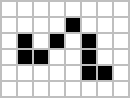
Long hook with tail is a 9-cell still life. It was found by Robert Wainwright in 1972, and was one of the last 9-bit still lifes to be reported.[1]
It is the 129th most common still life on Adam P. Goucher's Catagolue. Of the ten 9-cell still lifes, it is the second rarest.
Catalysis
Long hook with tail can sometimes be used as a block catalyst. Since it is a rock during catalysis, it can be used when the block gets destroyed by nearby junk while undergoing catalysis. An example can be seen in a high-clearance variant of the eater 5 that allows the compression of Herschel loop oscillators to periods of 57, 58, 59, and 60. For more of the usage of this catalyst and other block-replacement catalysts, see Tutorials/Catalyses#Block_replacements.
|
All strict still lifes with a population of 23 or fewer cells, all oscillators with 16 or fewer cells, and all spaceships with 35 or fewer cells are known to be glider-constructible. A glider synthesis of this object can be found in the infobox to the right.
See also
References
- ↑ Robert Wainwright (September 1972). Lifeline, vol 5, pages 4, 6.
External links
- The 10 nine-bit still-lifes at Mark D. Niemiec's Life Page
- Patterns
- Patterns with Catagolue frequency class 23
- Natural periodic objects
- Periodic objects with minimum population 9
- Patterns with 9 cells
- Patterns found by Robert Wainwright
- Patterns found in 1972
- Patterns that can be constructed with 5 gliders
- Still lifes
- Strict still lifes
- Strict still lifes with 9 cells
- Diagonal line stabilisations
- Catalysts