Long hook with tail: Difference between revisions
Carson Cheng (talk | contribs) Mentioned catalysis |
|||
| Line 25: | Line 25: | ||
== [[List of common still lifes|Commonness]] == | == [[List of common still lifes|Commonness]] == | ||
It is the 129th most common still life on [[Adam P. Goucher]]'s [[Catagolue]]. Of the ten 9-cell still lifes, it is the second rarest. | It is the 129th most common still life on [[Adam P. Goucher]]'s [[Catagolue]]. Of the ten 9-cell still lifes, it is the second rarest. | ||
==Catalysis== | |||
Long hook with tail can sometimes be used as a block catalyst. Since it is a [[rock]] during catalysis, it can be used when the block catalysis fails because of junk that interacts the block as it is undergoing a catalysis. An example can be seen in a high-clearance variant of the eater 5. For more of the usage of this catalyst and other block-replacement catalysts, see [[Tutorials/Catalyses#Block_replacements]]. | |||
{|style="margin:auto;width:80%;" | |||
|{{EmbedViewer | |||
|pname = eater5variant | |||
|position = center | |||
|viewerconfig = #C [[ THUMBSIZE 2 ]] | |||
|caption = A variation of the tub-with-tail eater using a long hook with tail | |||
}} | |||
== [[Glider synthesis]] == | == [[Glider synthesis]] == | ||
Revision as of 23:49, 10 September 2022
| Long hook with tail | |||||||||
| View static image | |||||||||
| Pattern type | Strict still life | ||||||||
|---|---|---|---|---|---|---|---|---|---|
| Number of cells | 9 | ||||||||
| Bounding box | 6 × 4 | ||||||||
| Frequency class | 23.1 | ||||||||
| Static symmetry | Unspecified | ||||||||
| Discovered by | Robert Wainwright | ||||||||
| Year of discovery | 1972 | ||||||||
| |||||||||
| |||||||||
| |||||||||
| |||||||||
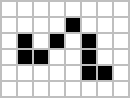
Long hook with tail is a 9-cell still life. It is the long version of a hook with tail. It is used in an alternate form of the tub-with-tail eater that allows the compression of Herschel loop oscillators to periods of 57, 58, 59, and 60. It was found by Robert Wainwright in 1972, and was one of the last 9-bit still lifes to be reported.[1]
It is the 129th most common still life on Adam P. Goucher's Catagolue. Of the ten 9-cell still lifes, it is the second rarest.
Catalysis
Long hook with tail can sometimes be used as a block catalyst. Since it is a rock during catalysis, it can be used when the block catalysis fails because of junk that interacts the block as it is undergoing a catalysis. An example can be seen in a high-clearance variant of the eater 5. For more of the usage of this catalyst and other block-replacement catalysts, see Tutorials/Catalyses#Block_replacements.
All strict still lifes with a population of 23 or fewer cells, all oscillators with 16 or fewer cells, and all spaceships with 35 or fewer cells are known to be glider-constructible. A glider synthesis of this object can be found in the infobox to the right. See alsoReferences
External links
|
- Patterns
- Patterns with Catagolue frequency class 23
- Natural periodic objects
- Periodic objects with minimum population 9
- Patterns with 9 cells
- Patterns found by Robert Wainwright
- Patterns found in 1972
- Patterns that can be constructed with 5 gliders
- Still lifes
- Strict still lifes
- Strict still lifes with 9 cells
- Diagonal line stabilisations
- Catalysts