Pulsar quadrant: Difference between revisions
Jump to navigation
Jump to search
not a small constructible periodic object, since it's an oscillator with 18 cells |
Haycat2009 (talk | contribs) m Update |
||
| Line 9: | Line 9: | ||
|h = 8 | |h = 8 | ||
|v = 0.46 | |v = 0.46 | ||
|rotor = Pulsar | |||
|discoverer = David Buckingham | |discoverer = David Buckingham | ||
|discoveryear = 1973 | |discoveryear = 1973 | ||
Revision as of 13:52, 3 January 2024
| Pulsar quadrant | |||||||||
| View animated image | |||||||||
| View static image | |||||||||
| Pattern type | Oscillator | ||||||||
|---|---|---|---|---|---|---|---|---|---|
| Number of cells | 18 | ||||||||
| Bounding box | 9 × 9 | ||||||||
| Period | 3 (mod: 3) | ||||||||
| Heat | 8 | ||||||||
| Volatility | 0.46 | 0.46 | ||||||||
| Kinetic symmetry | Unspecified | ||||||||
| Rotor type | Pulsar | ||||||||
| Discovered by | David Buckingham | ||||||||
| Year of discovery | 1973 | ||||||||
| |||||||||
| |||||||||
| |||||||||
| |||||||||
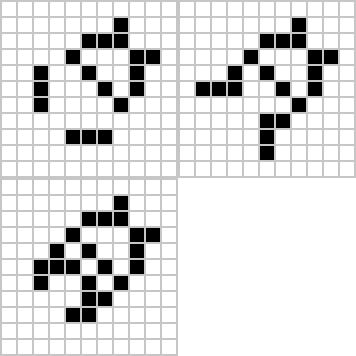

Pulsar quadrant (or pulse) is a period-3 oscillator that was found by David Buckingham in July 1973.[1] It consists of a quarter of the outer part of a pulsar stabilized by a cis-fuse with two tails.
Information on this oscillator's commonness with respect to other naturally-occurring patterns is currently unknown.
See also
References
- ↑ Dean Hickerson's oscillator stamp collection. Retrieved on March 14, 2020.
External links
- Pulsar quadrant at the Life Lexicon
- 18P3.39 at Heinrich Koenig's Game of Life Object Catalogs
Categories:
- Patterns
- Oscillators with 18 cells
- Periodic objects with minimum population 18
- Patterns with 18 cells
- Patterns found by David Buckingham
- Patterns found in 1973
- Patterns that can be constructed with 9 gliders
- Oscillators
- Oscillators with period 3
- Oscillators with mod 3
- Oscillators with heat 8
- Oscillators with volatility 0.46
- Oscillators with strict volatility 0.46
- Oscillators with rotor Pulsar
- Patterns with bilateral diagonal symmetry
- Sparkers
- Sparkers with period 3
- Weak sparkers
- Natural periodic objects