Integral with hook and tail: Difference between revisions
Jump to navigation
Jump to search
all 12-bit still lifes found in Lifeline Volume 10; overall frequency not unknown |
Carson Cheng (talk | contribs) Add notability tag |
||
| Line 1: | Line 1: | ||
{{notability}} | |||
{{Stilllife | {{Stilllife | ||
|name = Integral with hook and tail | |name = Integral with hook and tail | ||
Revision as of 14:45, 4 July 2022

|
This article may not meet the LifeWiki notability guidelines.
Please help to establish notability by adding external, independent sources about the topic. If notability cannot be established, the article is likely to be merged or deleted. |
| Integral with hook and tail | |||||||||
| View static image | |||||||||
| Pattern type | Strict still life | ||||||||
|---|---|---|---|---|---|---|---|---|---|
| Number of cells | 12 | ||||||||
| Bounding box | 7 × 5 | ||||||||
| Frequency class | 29.9 | ||||||||
| Static symmetry | Unspecified | ||||||||
| Discovered by | Robert Wainwright Everett Boyer | ||||||||
| Year of discovery | 1973 | ||||||||
| |||||||||
| |||||||||
| |||||||||
| |||||||||

|
It has been proposed that this page be moved to Hook line ponytail due to the following reason: There's barely anything "integral" about this, so substitutive nomenclature isn't a good idea and causes unnecessary confusion. "Hook" and "line" are established and clearly visible; "ponytail" would be the name for the five-cell tail-plus-one-cell component (halfway between a "tail" and "hooked tail"). |
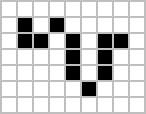
The integral with hook and tail is a 12-cell still life.
Among the 121 still lifes with 12 cells, this is the 66th most common still life according to Catagolue.
A 5-glider synthesis of this still life was found in January 2020.[1]
See also
References
- ↑ Ian07 (January 18, 2020). Re: Randomly enumerating glider syntheses (discussion thread) at the ConwayLife.com forums
External links
- 12.116 at Mark D. Niemiec's Life Page
- 12.92 at Heinrich Koenig's Game of Life Object Catalogs
Categories:
- Patterns
- Patterns with Catagolue frequency class 29
- Natural periodic objects
- Periodic objects with minimum population 12
- Patterns with 12 cells
- Patterns found by Robert Wainwright
- Patterns found by Everett Boyer
- Patterns found in 1973
- Patterns that can be constructed with 5 gliders
- Still lifes
- Strict still lifes
- Strict still lifes with 12 cells