Cavity: Difference between revisions
Jump to navigation
Jump to search
No edit summary |
this is extremely common, so discoveryear 1970 (although not ruling out 1969) |
||
| Line 6: | Line 6: | ||
|bx = 4 | |bx = 4 | ||
|by = 3 | |by = 3 | ||
|discoveryear = 1970 | |||
|rulespecial = [[Conway's Game of Life|Conway Life]] | |rulespecial = [[Conway's Game of Life|Conway Life]] | ||
|plaintext = true | |plaintext = true | ||
Revision as of 14:58, 30 May 2022
| Cavity | |||||||
| View static image | |||||||
| Pattern type | Spark | ||||||
|---|---|---|---|---|---|---|---|
| Number of cells | 6 | ||||||
| Bounding box | 4 × 3 | ||||||
| Static symmetry | Unspecified | ||||||
| Discovered by | Unknown | ||||||
| Year of discovery | 1970 | ||||||
| |||||||
- This article is about the spark and p2 oscillator component. For the p2 oscillator also referred to as "cavity", see Eater plug.
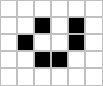
Cavity[notes 1] is a common polyplet spark, and is one of three sparks which can be obtained by removing one cell from a loaf.
Like with the banana spark, it can be used as a component in oscillator of period 2 by applying a bit spark to the duoplet-shaped region, which produces a mirrored version of the cavity. The smallest oscillator demonstrating this reaction, phoenix with cavity, has 15 cells. By flops can similarly have its flutter sections substituted with cavities to yield the 16-cell by flops with cavity or 19-cell by flops with two cavities.
Notes
- ↑ from "Phoenix w/ cavity": https://conwaylife.com/ref/mniemiec/p2.htm#p2-15