Long hook with tail: Difference between revisions
m fc |
No edit summary |
||
| (22 intermediate revisions by 7 users not shown) | |||
| Line 6: | Line 6: | ||
|by = 4 | |by = 4 | ||
|fc = 23.1 | |fc = 23.1 | ||
|symmetry = n | |||
|discoverer = Robert Wainwright | |||
|discoveryear = 1972 | |||
|rulemin = B/S23 | |rulemin = B/S23 | ||
|rulemax = B35678/S012345678 | |rulemax = B35678/S012345678 | ||
|rulespecial = [[Conway's Game of Life|Conway Life]], [[HighLife]] | |rulespecial = [[Conway's Game of Life|Conway Life]], [[HighLife]] | ||
|isorulemin = B/S2-i3nr | |||
|isorulemax = B2ikn34-ajnr5678/S012345678 | |||
|synthesis = 5 | |synthesis = 5 | ||
|synthesisRLE = true | |synthesisRLE = true | ||
|plaintext = true | |plaintext = true | ||
|rle = true | |rle = true | ||
| Line 18: | Line 21: | ||
|niemiecid = 9.8 | |niemiecid = 9.8 | ||
|pentadecathlonid = 9.8 | |pentadecathlonid = 9.8 | ||
|viewerconfig = [[ ZOOM 57 ]] | |||
}} | }} | ||
'''Long hook with tail''' is a | '''Long hook with tail''' is a {{cells|9|text=9-cell}} [[still life]]. It was found by [[Robert Wainwright]] in {{year|1972}}, and was one of the last 9-bit still lifes to be reported.<ref>{{CiteLifeline|vol=5|pages=pages 4, 6}}</ref> | ||
== | == Catalysis == | ||
Long hook with tail can sometimes be used as a block catalyst. Since it is a [[rock]] during catalysis, it can be used when the block gets destroyed by nearby junk while undergoing catalysis. An example can be seen in a high-clearance variant of the eater 5 that allows the compression of [[Herschel]] [[Herschel loop|loop]] [[oscillator]]s to [[period]]s of {{period|57|brief}}, {{period|58|brief}}, {{period|59|brief}}, and {{period|60|brief}}. For more of the usage of this catalyst and other block-replacement catalysts, see [[Tutorials/Catalyses#Block_replacements]]. | |||
==External links== | {| style="margin:auto; width:40%" | ||
{{LinkCatagolue|xs9_178426}} | |{{EmbedViewer | ||
{{LinkNiemiec|p1.htm#p1-9| | |pname = eater5variant | ||
|position = center | |||
|viewerconfig = #C [[ THUMBSIZE 2 ]] | |||
|caption = A variation of the tub-with-tail eater using a long hook with tail | |||
}} | |||
|} | |||
== Occurrence == | |||
{{related|List of common still lifes|Most common objects on Catagolue}} | |||
{{CatagolueSLRarity | |||
|population = 9 | |||
|absrank = 129th | |||
|abslesscommonthan = house siamese shillelagh | |||
|absmorecommonthan = block on bun tie bun | |||
|popspecial = true | |||
|popspecialtext = It is the second-rarest still life with 9 cells, being 5 times less common than [[long canoe]] but 3 times as common as [[long^3 snake]]. | |||
|date = May 14, 2023 | |||
}} | |||
== Glider synthesis == | |||
{{main|Glider synthesis}} | |||
The long hook with tail is known for being more difficult to synthesize than other still lifes of this size. Of the 31 strict still lifes of 9 bits and below, only 2, long hook with tail and [[long^3 snake]], cost 5 gliders, which is the maximum glider cost in this group of small still lifes. | |||
== See also == | |||
* [[Hook with tail#Hook with tail family|Hook with tail family]] | |||
== References == | |||
<references /> | |||
== External links == | |||
* {{LinkCatagolue|xs9_178426}} | |||
* {{LinkNiemiec|p1.htm#p1-9|The 10 nine-bit still-lifes|rle=0/9-8.rle}} | |||
* {{LinkPentadecathlonObject|id=9.8}} | |||
[[Category:Diagonal line stabilisations]] | [[Category:Diagonal line stabilisations]] | ||
[[Category:Catalysts]] | |||
__NOTOC__ | |||
Latest revision as of 10:32, 27 August 2024
| Long hook with tail | |||||||||
| View static image | |||||||||
| Pattern type | Strict still life | ||||||||
|---|---|---|---|---|---|---|---|---|---|
| Number of cells | 9 | ||||||||
| Bounding box | 6 × 4 | ||||||||
| Frequency class | 23.1 | ||||||||
| Static symmetry | n (C1) | ||||||||
| Discovered by | Robert Wainwright | ||||||||
| Year of discovery | 1972 | ||||||||
| |||||||||
| |||||||||
| |||||||||
| |||||||||
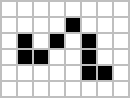
Long hook with tail is a 9-cell still life. It was found by Robert Wainwright in 1972, and was one of the last 9-bit still lifes to be reported.[1]
Catalysis
Long hook with tail can sometimes be used as a block catalyst. Since it is a rock during catalysis, it can be used when the block gets destroyed by nearby junk while undergoing catalysis. An example can be seen in a high-clearance variant of the eater 5 that allows the compression of Herschel loop oscillators to periods of 57, 58, 59, and 60. For more of the usage of this catalyst and other block-replacement catalysts, see Tutorials/Catalyses#Block_replacements.
|
Occurrence
Long hook with tail is the 129th most common still life on Adam P. Goucher's Catagolue, being less common than house siamese shillelagh but more common than block on bun tie bun. It is the second-rarest still life with 9 cells, being 5 times less common than long canoe but 3 times as common as long^3 snake.[2]
Glider synthesis
- Main article: Glider synthesis
The long hook with tail is known for being more difficult to synthesize than other still lifes of this size. Of the 31 strict still lifes of 9 bits and below, only 2, long hook with tail and long^3 snake, cost 5 gliders, which is the maximum glider cost in this group of small still lifes.
See also
References
- ↑ Robert Wainwright (September 1972). Lifeline, vol 5, pages 4, 6.
- ↑ Adam P. Goucher. "Statistics". Catagolue. Retrieved on May 14, 2023.
External links
- Long hook with tail at Adam P. Goucher's Catagolue
- The 10 nine-bit still-lifes at Mark D. Niemiec's Life Page (download pattern file: 0/9-8.rle)
- 9.8 at Heinrich Koenig's Game of Life Object Catalogs
- Patterns
- Patterns with Catagolue frequency class 23
- Natural periodic objects
- Periodic objects with minimum population 9
- Patterns with 9 cells
- Patterns found by Robert Wainwright
- Patterns found in 1972
- Patterns that can be constructed with 5 gliders
- Still lifes
- Strict still lifes
- Strict still lifes with 9 cells
- Strict still lifes with n symmetry
- Diagonal line stabilisations
- Catalysts