|rulespecial = [[Conway's Game of Life|Conway's Life]]
|isorulemin = B3-k/S23
|isorulemin = B3-k/S23
|isorulemax = B34e5ce6ac7e8/S234cei5ekn6-ac78
|isorulemax = B34e5ce6ac7e8/S234cei5ekn6-ac78
Line 25:
Line 24:
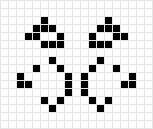
'''Pufferfish''' is a [[puffer]] discovered by Richard Schank in {{year|2014}}. Having been found in a symmetric [[soup]], the puffer is [[semi-natural]].<ref>{{LinkForumThread|format=ref|p=14510|title=Re: Soup search results|author=Richard Schank|date=November 24, 2014|accessdate=November 25, 2014}}</ref> It consists of a pair of [[B-heptomino]]es whose debris is stabilised by a backend.
'''Pufferfish''' is a [[puffer]] discovered by Richard Schank in {{year|2014}}. Having been found in a symmetric [[soup]], the puffer is [[semi-natural]].<ref>{{LinkForumThread|format=ref|p=14510|title=Re: Soup search results|author=Richard Schank|date=November 24, 2014|accessdate=November 25, 2014}}</ref> It consists of a pair of [[B-heptomino]]es whose debris is stabilised by a backend.
It is the first known [[c/2]] object that doesn't have any parts of periods 2 or 4.
It is the first known [[c/2]] object that doesn't have any parts of periods 2 or 4. While the first two or three rows might be considered to be period 2 or 4, they are directly dependent on following rows for support.
== Period-36 technology ==
== Period-36 technology ==
Line 38:
Line 37:
}}
}}
On December 27, 2014 Ivan Fomichev found a non-trivial (dependent) c/2 [[fuse]] of period 36 for pufferfish's exhaust, enabling him to assemble the first wholly high-period c/2 [[spaceship]] and [[rake]].<ref>{{LinkForumThread|format=ref|p=15269|title=Pufferfish and companions|author=Ivan Fomichev|date=December 27, 2014|accessdate=December 28, 2014}}</ref> A few days later [[Nico Brown]] found some smaller rakes.<ref>{{LinkForumThread|format=ref|p=15359|title=Re: Pufferfish and companions|author=Nico Brown|date=December 29, 2014|accessdate=December 29, 2014}}</ref>
On December 27, 2014 Ivan Fomichev found a non-trivial (dependent) c/2 [[fuse]] of period 36 for pufferfish's exhaust, enabling him to assemble the first wholly high-period c/2 [[spaceship]] and [[rake]].<ref>{{LinkForumThread|format=ref|p=15269|title=Pufferfish and companions|author=Ivan Fomichev|date=December 27, 2014|accessdate=December 28, 2014}}</ref> A few days later [[Nora Brown]] found some smaller rakes.<ref>{{LinkForumThread|format=ref|p=15359|title=Re: Pufferfish and companions|author=Nora Brown|date=December 29, 2014|accessdate=December 29, 2014}}</ref>
The first semi-natural period-36 puffer appeared in the H4_+1 pseudosymmetry{{refn|Soup: [https://catagolue.hatsya.com/hashsoup/H4_+1/o_gWnK9hX5hzXY167997392/b3s23 link], attribute page: [https://catagolue.hatsya.com/attribute/yl36_1_16_57d2cdbc68803b96439fa78ed3760d21/b3s23/H4_+1 link]}} on November 24, {{year|2022}}. It uses the mechanism of the first viewer window below but with climbers on both sides instead of just one.
The first semi-natural period-36 puffer appeared in the H4_+1 pseudosymmetry{{refn|Soup: [https://catagolue.hatsya.com/hashsoup/H4_+1/o_gWnK9hX5hzXY167997392/b3s23 link], attribute page: [https://catagolue.hatsya.com/attribute/yl36_1_16_57d2cdbc68803b96439fa78ed3760d21/b3s23/H4_+1 link]}} on November 24, {{year|2022}}. It uses the mechanism of the first viewer window below but with climbers on both sides instead of just one.
Pufferfish is a puffer discovered by Richard Schank in 2014. Having been found in a symmetric soup, the puffer is semi-natural.[1] It consists of a pair of B-heptominoes whose debris is stabilised by a backend.
It is the first known c/2 object that doesn't have any parts of periods 2 or 4. While the first two or three rows might be considered to be period 2 or 4, they are directly dependent on following rows for support.
On December 27, 2014 Ivan Fomichev found a non-trivial (dependent) c/2 fuse of period 36 for pufferfish's exhaust, enabling him to assemble the first wholly high-period c/2 spaceship and rake.[2] A few days later Nora Brown found some smaller rakes.[3]
The first semi-natural period-36 puffer appeared in the H4_+1 pseudosymmetry[4] on November 24, 2022. It uses the mechanism of the first viewer window below but with climbers on both sides instead of just one.
The second pufferfish-producing soup Richard Schank found resulted in a 15-glider synthesis proposed by Chris Cain.[5] On January 8, 2015 Ivan Fomichev made a p160 pufferfish breeder.[6]
Chris Cain found a 60-glider synthesis of a pufferfish-based spaceship in February 2015.[7] Versions with arbitrarily increased length and population are trivially constructible at the same total cost in gliders.