Fore and back: Difference between revisions
rewrite, use templates for references, consistent formatting for bulleted lists, remove markup from section headings, longer link text |
No edit summary |
||
| (2 intermediate revisions by the same user not shown) | |||
| Line 12: | Line 12: | ||
|h = 4 | |h = 4 | ||
|v = 0.15 | |v = 0.15 | ||
|symmetry = .cxc | |||
|rotor = Pole 2 | |rotor = Pole 2 | ||
|discoverer = Achim Flammenkamp | |discoverer = Achim Flammenkamp | ||
| Line 33: | Line 34: | ||
== Commonness == | == Commonness == | ||
{{main|List of common oscillators}} | {{main|List of common oscillators}} | ||
Fore and back is about the thirty-eighth most common naturally-occurring oscillator in [[Achim Flammenkamp's census]], being less common than [[boat on spark coil]] and [[block on griddle]], about as common as [[xp2_8e1t2gozw23]], and more common than [[trans-block on | Fore and back is about the thirty-eighth most common naturally-occurring oscillator in [[Achim Flammenkamp's census]], being less common than [[boat on spark coil]] and [[block on griddle]], about as common as [[xp2_8e1t2gozw23]], and more common than [[trans-block on candlefrobra]] and [[trans-beacon down on long bookend]].<ref>{{citeAchim|accessdate=January 15, 2009}}</ref> It is the 33rd most common oscillator on [[Adam P. Goucher]]'s [[Catagolue]]. It is the most common oscillator that is generally agreed to be a [[billiard table]], though some instead give this title to the more common [[test tube baby]], which counts under a looser definition.<ref name="post78873" /> | ||
== Formation == | == Formation == | ||
| Line 73: | Line 74: | ||
* {{LinkCatagolue|xp2_ca1n0brz330321}} | * {{LinkCatagolue|xp2_ca1n0brz330321}} | ||
* {{LinkPentadecathlonObject|24P2.142}} | * {{LinkPentadecathlonObject|24P2.142}} | ||
__NOTOC__ | __NOTOC__ | ||
Latest revision as of 10:42, 6 August 2024
| Fore and back | |||||||||
| View animated image | |||||||||
| View static image | |||||||||
| Pattern type | Oscillator | ||||||||
|---|---|---|---|---|---|---|---|---|---|
| Oscillator type | Muttering moat | ||||||||
| Billiard table | |||||||||
| Number of cells | 24 | ||||||||
| Bounding box | 7 × 7 | ||||||||
| Frequency class | 30.6 | ||||||||
| Period | 2 (mod: 1) | ||||||||
| Heat | 4 | ||||||||
| Volatility | 0.15 | 0.15 | ||||||||
| Kinetic symmetry | .cxc | ||||||||
| Rotor type | Pole 2 | ||||||||
| Discovered by | Achim Flammenkamp | ||||||||
| Year of discovery | 1994 | ||||||||
| |||||||||
| |||||||||
| |||||||||
| |||||||||
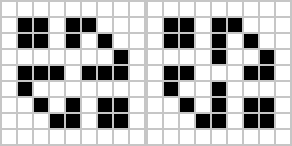
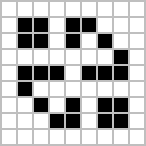
Fore and back (or complementary blinker[1]) is a period-2 oscillator that was found by Achim Flammenkamp on July 12, 1994.[2] It has the same rotor as the blinker.
Commonness
- Main article: List of common oscillators
Fore and back is about the thirty-eighth most common naturally-occurring oscillator in Achim Flammenkamp's census, being less common than boat on spark coil and block on griddle, about as common as xp2_8e1t2gozw23, and more common than trans-block on candlefrobra and trans-beacon down on long bookend.[3] It is the 33rd most common oscillator on Adam P. Goucher's Catagolue. It is the most common oscillator that is generally agreed to be a billiard table, though some instead give this title to the more common test tube baby, which counts under a looser definition.[4]
Formation
Fore and back typically forms via the predecessor below.
| (click above to open LifeViewer) |
Glider synthesis
In August 2013, a 24-glider synthesis of this oscillator was found by Martin Grant, based on a soup provided by Lewis Patterson. Several days later Mark Niemiec improved this result, having found a 20-glider synthesis.[5]
In October 2014, Tanner Jacobi found a predecessor for this pattern based on a soup from Adam P. Goucher's apgsearch script,[6] which was eventually optimized to a 6-glider synthesis[7] in November.
See also
References
- ↑ "Complementary blinker". The Life Lexicon. Stephen Silver. Retrieved on December 3, 2018.
- ↑ Dean Hickerson's oscillator stamp collection. Retrieved on March 14, 2020.
- ↑ Achim Flammenkamp (September 7, 2004). "Most seen natural occurring ash objects in Game of Life". Retrieved on January 15, 2009.
- ↑ Dave Greene (July 3, 2019). Re: Thread for basic questions (discussion thread) at the ConwayLife.com forums
- ↑ Lewis Patterson (August 4, 2013). Re: Synthesising Oscillators (discussion thread) at the ConwayLife.com forums
- ↑ Tanner Jacobi (October 15, 2014). Re: Soup search results (discussion thread) at the ConwayLife.com forums
- ↑ Tanner Jacobi (November 8, 2014). Re: Soup search results (discussion thread) at the ConwayLife.com forums
External links
- Fore and back at the Life Lexicon
- Fore and back at Adam P. Goucher's Catagolue
- 24P2.142 at Heinrich Koenig's Game of Life Object Catalogs
- Patterns
- Patterns with Catagolue frequency class 30
- Natural periodic objects
- Oscillators with 24 cells
- Periodic objects with minimum population 24
- Patterns with 24 cells
- Patterns found by Achim Flammenkamp
- Patterns found in 1994
- Patterns that can be constructed with 5 gliders
- Oscillators
- Muttering moats
- Billiard tables
- Oscillators with period 2
- Oscillators with mod 1
- Oscillators with heat 4
- Oscillators with volatility 0.15
- Oscillators with strict volatility 0.15
- Oscillators with .cxc symmetry
- Oscillators with rotor Pole 2